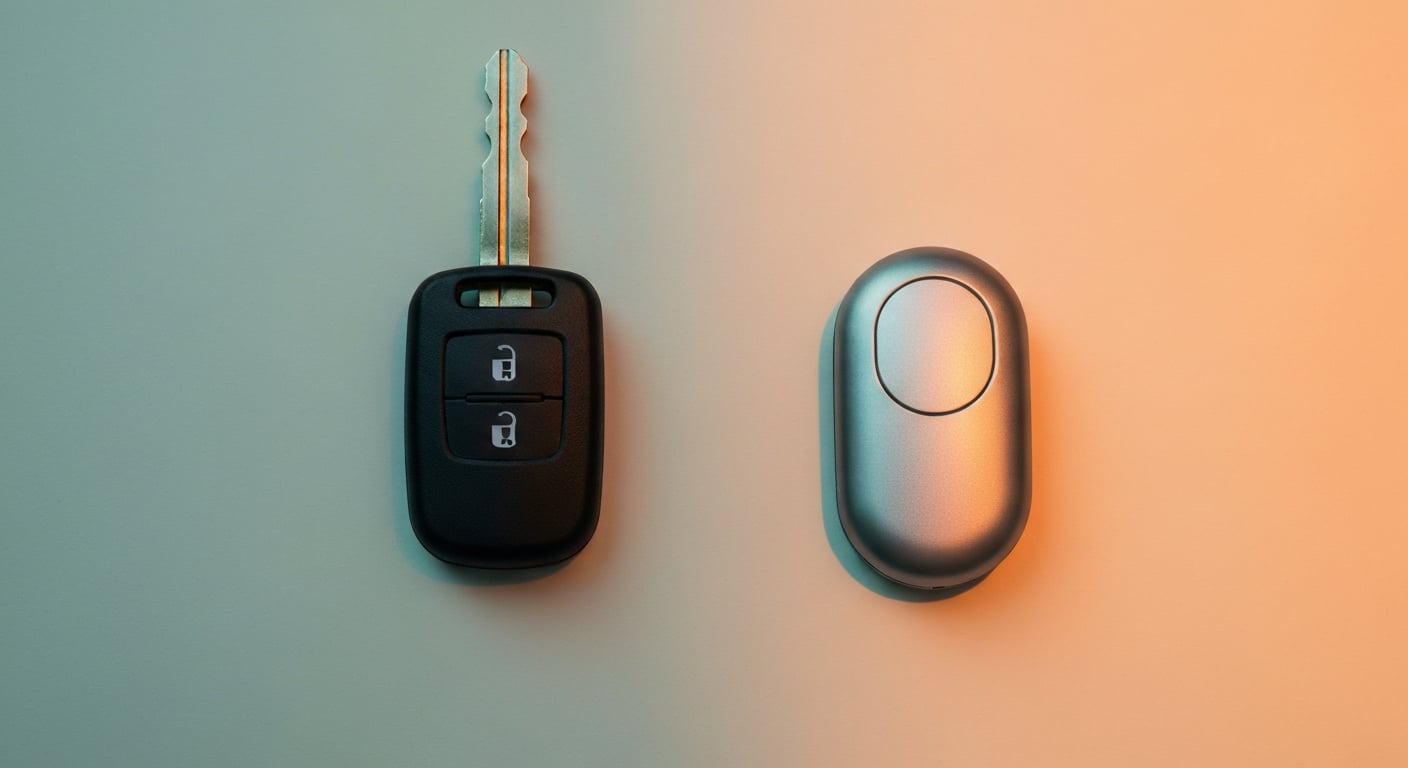
Toyota and Lexus vehicles stay on the road a long time, which produces a distinctive pattern in key work: the same driveway can hold a twenty-year-old Camry and a two-year-old Highlander, and the keys for them have almost nothing in common beyond the badge.
As of September 2026, here is what actually determines a Toyota or Lexus key quote — and why the answer so often turns on a detail you cannot see from the outside.
Three questions price the job
Before any technician can quote you honestly, three facts have to be established. Everything else is rounding.
Does the vehicle start with a twisted key or a button? This is the single largest split. A bladed key with a chip in the head and a proximity smart fob are different products at very different price points, and the gap is mostly hardware. We quantify the general shape of that difference in smart key replacement cost versus transponder.
Which chip generation is inside? Toyota ran several generations of transponder across an unusually long production span. Shops routinely refer to two of them by informal single-letter names, and the later generation adopted meaningfully stronger security. You cannot tell them apart by looking; the vehicle identification number and model year decide it.
How many working keys survive? One working key means a technician can add another. Zero working keys means originating from nothing, which is a different procedure with a different price and a longer visit. Published consumer guidance puts modern key replacement broadly in the low-to-mid hundreds of dollars, rising for proximity systems and rising again when nothing remains [2].
The generations, plainly
Toyota did not market these transitions to owners, so the vocabulary comes from the trade. What matters is the practical consequence.
Pre-immobilizer keys. Plain steel, no electronics. Common on older economy models and trucks. Cutting only, no programming, cheapest job on the board.
First-generation chip keys. A chip in a bladed key head. Widely supported by aftermarket equipment and inexpensive as chip keys go. Many of these vehicles also support an owner-performed procedure to add a key when working keys already exist — genuinely useful, and genuinely useless the day you lose the last one.
Later-generation chip keys. The stronger-security transponder that arrived on the second half of the range. Coverage among independent shops is broad now, but it took the aftermarket time to catch up when these vehicles were new, and that history is the origin of a lot of stale "only the dealer can do it" advice still circulating online.
Smart keys and push-button start. The pocket fob with a hidden emergency blade, standard across most of the recent Lexus range and the upper half of the Toyota range. Highest parts cost, most involved security process, and the format where all-keys-lost work becomes materially harder.
The wider industry version of this timeline, applicable to any make, is in our car key technology by model year reference.
What that means in a quote
| Your vehicle | What is supplied | Programming | Relative cost |
|---|---|---|---|
| Older model, plain key | Cut blank | None | Lowest |
| Bladed chip key, one working key left | Cut and chipped key | Add-a-key procedure | Low to moderate |
| Bladed chip key, no keys left | Originated key | Full origination | Moderate, plus premium |
| Smart fob, one working fob left | Smart fob, blade cut | Add-a-key procedure | High |
| Smart fob, no fobs left | Smart fob, blade cut | Full origination, longer visit | Highest |
The pattern in that table is the pattern across the whole trade: the format sets the floor, and the absence of a working key sets the premium. Labor rates layered on top vary regionally, which the occupational wage data for the trade makes visible [5] — and is the reason an identical job carries different numbers in different parts of the country.
All keys lost on a smart-key Toyota
This deserves its own section because it is the scenario people most often underestimate.
With no working fob, the technician cannot simply add a key. The vehicle has to be persuaded to accept a credential it has never seen, and on a modern vehicle that means authenticated access to manufacturer security data through the recognised industry channel, with the technician establishing that the vehicle is yours before anything is written [1]. On smart-key vehicles the process also carries its own required steps and waiting periods, which is why the visit runs longer than an add-a-key job on the same car.
Two practical consequences. First, have your paperwork ready before the technician arrives — registration or title, and photo identification that matches. Our guide to proof of ownership covers the awkward cases, such as a vehicle still titled to a seller or to a company. Second, do not assume the quoted arrival time is the finish time; the mechanics of how long car key replacement takes explain where the hours actually go.
The full sequence, for any make, is set out in all keys lost and secure data release explained.
Hybrids, plug-ins and the silent start
A Prius, a hybrid Camry or a Lexus hybrid does not use an exotic key. The immobilizer and smart-key families are shared with the conventional models, so from a locksmith's point of view the work is comparable.
What genuinely differs is diagnosis. On a conventional car, an immobilizer refusal announces itself: the engine cranks and dies. On a hybrid there is no crank to hear, so a refusal to enter ready mode reads much like a dead twelve-volt battery, a dead fob battery, or a brake-switch fault. That ambiguity sends a fair number of owners to buy a key they did not need.
If your hybrid will not enter ready mode, check the twelve-volt battery and the fob battery before ordering anything. Vehicles that use a phone or a card as a credential add another layer again, which we cover in digital and EV car key replacement.
Buying the fob yourself
Toyota and Lexus fobs are widely sold online, and the temptation is obvious. Two cautions.
The first is compatibility. Fobs that look identical in photographs are frequently different variants, and the reliable check available to a consumer is the equipment authorization identifier printed on the fob itself, searchable in the public federal database [4]. Matching that identifier is not a guarantee, but mismatching it is close to a guarantee of failure.
The second is acceptance. Many shops will not program an owner-supplied part, because they cannot warrant hardware they did not source and a failed part turns a fixed-price job into an argument. Confirm the policy before you buy, not after. The broader trade-off is laid out in OEM versus aftermarket car keys.
Getting a straight answer on the phone
Give the shop the vehicle identification number, the model year, whether you twist or press to start, and how many working keys exist. Then ask for one total covering part, programming and travel, in writing before dispatch. Federal consumer guidance flags a price that changes on arrival, and a company that will not identify itself, as the two clearest warning signs in this trade [3].
A useful follow-up question specific to these vehicles: will any existing keys stop working? Some procedures clear every previously programmed credential. That is exactly what you want when a fob is genuinely lost and you would rather it be dead — and exactly what you do not want when you are simply adding a spare and still hold the original.
Whether a given shop covers your particular model year is not a matter of skill so much as of which software subscriptions the business currently pays for, which is why two competent shops in the same city give different answers. Why locksmith key coverage varies explains the economics, and what an automotive locksmith actually does is the wider primer.
When the smart key stops being detected
Before concluding that a Toyota or Lexus smart key has failed, work through the three cheap explanations in order.
The fob battery. A weakening coin cell shortens detection range long before it stops working entirely, so the first symptom is usually intermittent — the pattern read in full in your key works sometimes and not others: the vehicle recognises the fob at the door but not at the seat, or works in the morning and not at night. A new cell costs almost nothing and resolves a large share of these calls.
Radio interference. Proximity detection is a short-range radio conversation, and it can be swamped. A fob carried against a phone, a laptop bag, another vehicle's fob, or a location near a transmitter can all produce the same intermittent behaviour. Moving the fob to the other hand and retrying is a free diagnostic.
The backup start method. Most push-button vehicles have a documented way to start when the fob battery is flat, generally involving holding the fob against or near the start button so the vehicle can read it at close range. The exact position varies by model and it is in the owner manual. Knowing it is genuinely useful — it turns a dead battery from a tow into an inconvenience.
If all three come up empty and the vehicle refuses to start with a fob that the doors still respond to, the fault has probably moved from the credential to the vehicle. That is a diagnosis rather than a purchase, and it is worth paying for the diagnosis first.
The cheapest version of this job
It is the one you do while a working key still exists.
Adding a key to a Toyota or Lexus that already has one is a routine procedure. Originating from nothing on a smart-key vehicle is the most expensive thing in this article, and what replacement costs with no spare explains where that number comes from. The difference between those two invoices is larger than almost any other decision available to you, and the only input is timing.
If your vehicle currently has one key, treat that as the actionable finding. Search the directory for automotive locksmiths listed in your area, or get matched with screened car-key specialists — and get the spare cut before you need it.
Frequently asked questions
Why are some Toyota keys so much more expensive to replace than others?
Three things drive it: the chip generation inside the key, whether the vehicle uses a bladed key or a push-button smart fob, and whether any working key remains. A bladed chip key for an older Corolla and a smart fob for a recent Highlander are different objects with very different parts costs, and losing every key changes the method rather than adding a small fee.
Can an automotive locksmith program a Toyota smart key?
On most Toyota and Lexus vehicles in general circulation, yes. Coverage narrows on the newest model years, where blanks and software support lag the vehicle, and on a small number of platforms where the practical route remains the dealer. The answer is model-year specific, so ask the shop to confirm against your vehicle identification number rather than against the model name.
What does it mean when a shop asks whether my Toyota key is a G chip or an H chip?
Those are informal names for two generations of Toyota transponder used across a long run of vehicles, with the later one adopting stronger security. They are not visible from the outside, which is why the shop asks — the answer determines which equipment and which key blank the job needs. The vehicle identification number and model year usually settle it.
How long does a Toyota key replacement take?
The work at the vehicle is often well under an hour when a working key still exists. An all-keys-lost job on a smart-key vehicle takes longer, sometimes considerably, because the security process has its own required steps and waiting periods. Most of your total wait, though, is dispatch and drive time rather than the procedure itself.
Is a Prius or a hybrid different from any other Toyota?
Not in the way people expect. A hybrid or plug-in Toyota uses the same families of smart key and immobilizer as its conventional stablemates, so key work is comparable. What differs is the starting ritual — there is no cranking engine to listen to — which makes symptoms harder to read when you are trying to work out whether the fault is the key or something else.
Should I buy a Toyota key fob online and have someone program it?
It can work and it frequently backfires. Many shops decline to program owner-supplied parts because they cannot warrant them, and a fob that is the wrong variant is unprogrammable no matter who tries. If you go that route, match the equipment authorization identifier printed on your existing fob and confirm in advance that the shop will accept a supplied part.
Sources cited
- National Automotive Service Task Force — Secure Data Release System & Vehicle Security Professional registry (2024).
- AAA — Car key replacement cost guidance (2024).
- Federal Trade Commission — Hiring a Locksmith (2023).
- Federal Communications Commission — Equipment Authorization (FCC ID) search (2025).
- U.S. Bureau of Labor Statistics — Occupational employment and wages, locksmiths and safe repairers 49-3071 (2024).