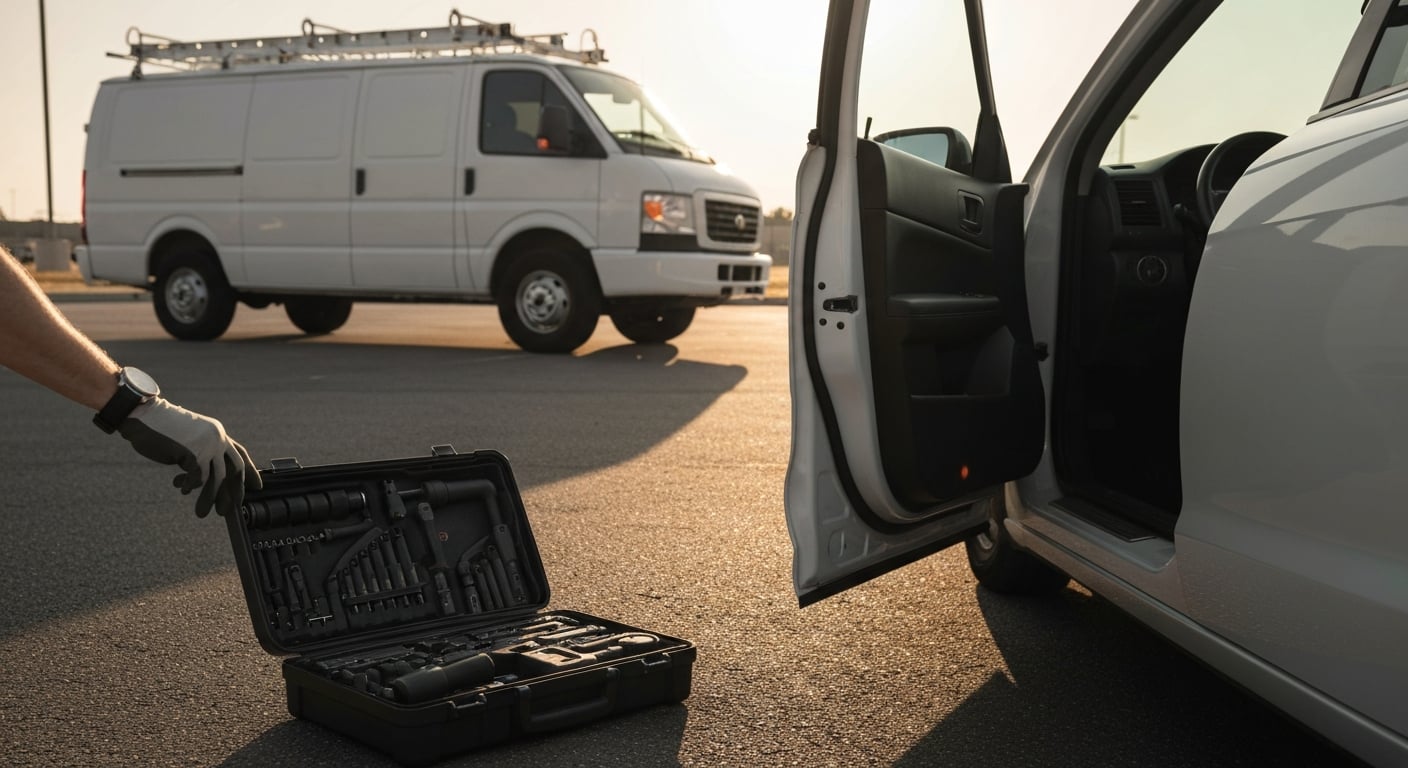
Short answer, as of July 2026: for most mainstream vehicles, a mobile automotive locksmith can replace a car key the same day — commonly a few hours from call to dispatch, plus roughly 20 to 90 minutes on site depending on whether you still have a working key. The dealership route is typically measured in days rather than hours, not because the work is harder but because the car has to get there and the appointment has to be scheduled.
The rest of this guide breaks the clock into stages, so you can tell which part of your particular wait is unavoidable and which part you can compress. It is also the honest version: there are three situations where same-day is genuinely not on the table, and you should know them before someone promises otherwise.
The five stages of the clock
Stage 1 — Finding and vetting a shop (10–30 minutes)
The stage people compress the most and should compress the least. A single bad choice here costs more time than every other stage combined, because a bait-and-switch dispatch operation may arrive, quote a much higher figure, and leave you starting over. Federal consumer guidance on getting the total price and the business's credentials in writing before work begins exists precisely because of that pattern [4].
Ten minutes spent on our seven-point verification check is time invested, not spent. If you would rather compress it structurally, get matched puts your vehicle details in front of screened automotive locksmiths in one step, which also gives you comparable quotes instead of a single take-it-or-leave-it number.
Stage 2 — Dispatch and travel (30 minutes to several hours)
The genuinely variable stage. It depends on how many technicians the shop has out, where they currently are, traffic, and how far you are from their coverage centre. A dense metro at 2pm on a Tuesday is a different proposition from a rural highway at 9pm.
Ask for an honest window rather than a reassuring one, and ask whether the technician will call when en route. A shop that quotes "20 minutes" regardless of where you are is not measuring anything.
Stage 3 — Identification and paperwork (5–15 minutes)
On arrival the technician confirms the vehicle — year, make, model, VIN — and verifies that you are entitled to a key. Expect photo ID plus a document tying you to the VIN. Where authenticated manufacturer key data is involved, that verification is a requirement of the credentialing framework, not a formality [2].
You can pre-compress this stage entirely: have the documents in hand before the van arrives.
Stage 4 — Cutting and programming (15 minutes to a few hours)
The work itself. Broad shape:
| Scenario | Typical on-site duration |
|---|---|
| Duplicate a mechanical key | Minutes |
| Add a transponder key, working key present | ~20–45 minutes |
| Add a proximity fob, working key present | ~30–60 minutes |
| All keys lost, mainstream platform | ~1–2 hours |
| All keys lost, premium or authenticated platform | 2+ hours, sometimes staged |
| Ignition or module fault discovered | Becomes a repair, not a key job |
Treat those as shapes rather than promises — the platform decides. The all-keys-lost rows are longer for a structural reason we explain in what an all-keys-lost job involves: with no working key to vouch for the new one, the immobilizer's trust has to be rebuilt from scratch, and that architecture exists because of decades of theft-prevention policy [3].
Stage 5 — Verification (5–10 minutes)
Start the engine, test remote lock and unlock, panic, trunk, and proximity detection if applicable. Confirm what happened to any previously stored keys. Skipping this stage is how people discover at 7am that the remote never worked.
The security wait nobody warns you about
On several platforms the immobilizer imposes a mandatory delay during key learning — an intentional anti-brute-force measure. From the passenger seat it looks like the technician is idling. It is not shortenable by any tool, on any budget, by any shop.
If your platform has one, a competent technician will tell you the length up front when asked. Build it into your plan rather than reading it as slow work.
Why the dealer route runs in days
Dealers are not slower at the bench. They are slower end to end, for logistics reasons:
- The vehicle must arrive. A car that will not start needs a tow, which is a scheduling problem and a real cost.
- Service departments book by appointment. Same-day walk-in capacity for a key job is uncommon.
- Fobs are often ordered. High-volume platforms may be stocked; less common ones frequently are not.
- Authorization steps may be batched. Where an authenticated procedure is required, it happens on the service department's rhythm, not yours.
Where the dealer wins is the narrow set of platforms that genuinely require manufacturer-only authorization, and situations where the security module itself needs replacing and coding. Our dealer vs locksmith comparison works through where that line sits. The cost side runs the same direction — published guidance consistently shows the mobile route cheaper for mainstream vehicles once towing is counted [1] [6].
The three situations where same-day is not realistic
Be sceptical of anyone promising otherwise:
- The fob has to be ordered. Low-volume platforms and very new models. No amount of urgency creates stock in a van.
- The platform requires dealer-only authorization. A small but real set of vehicles. The honest answer is a tow and an appointment.
- The fault is not the key. If the receiver, the ignition node or the security module has failed, you are looking at a diagnostic and a repair. Buying another key does not fix a car that cannot read keys.
A shop that identifies one of these on the phone and tells you so has just saved you a wasted afternoon. That is a good sign, not a brush-off.
A worked example: the shape of a real afternoon
Abstract stage lists are hard to plan against, so here is a composite of the most common case — a mainstream sedan, push-to-start, one fob lost, one spare sitting at home forty minutes away.
1:10 pm. You realize the fob is gone. Fifteen minutes searching, which is correct — the cheapest possible outcome is finding it.
1:25 pm. You start calling. Two shops. The first opens with a price before asking anything, which you note and set aside. The second asks for the year, make, model and VIN, asks whether you have a spare, and texts an all-in figure with a two-to-four window.
1:40 pm. Booked. Here the spare at home matters enormously: because you have a working key available, this is an add-a-key job rather than an all-keys-lost recovery. If someone can bring it, say so — it can change both the price and the duration materially.
2:35 pm. The technician arrives, within the window. Five minutes confirming the vehicle and checking your ID against the registration.
2:45 pm. Work begins. With the spare present, enrollment on a mainstream platform runs comfortably inside the half-hour band, plus cutting the emergency blade.
3:15 pm. You are asked whether you want a third key while everything is set up. Deciding in advance means this is a planned answer rather than a decision under pressure.
3:25 pm. Verification: start, lock, unlock, panic, trunk, proximity. Invoice with the VIN and part numbers.
3:30 pm. Done — roughly two hours and twenty minutes from the moment you realized, of which under an hour was actual work. That ratio is the honest shape of most same-day key jobs, and it is why "how long does it take?" and "how long until I'm driving?" are different questions with different answers.
Change one variable — no spare anywhere — and the same afternoon runs to early evening, because you have moved into the all-keys-lost column of the table above.
Five things you can do to compress your own timeline
- Have documents ready — photo ID and something tying you to the VIN.
- Locate the VIN through the base of the windshield or the driver's door jamb, and read it out when you call.
- Answer the working-key question precisely. "I have one at home 20 minutes away" changes both the price and the duration; say so.
- Confirm access. Underground garages, gated lots and tow yards all need arrangements before the technician arrives.
- Order the spare in the same visit. It adds a short increment now and removes a whole future call-out later.
Point five is worth repeating because it is the one people decline in the moment and regret later. The setup time is already paid for.
Regional reality
Two identical vehicles in two states can have genuinely different dispatch times and prices. Coverage density varies, travel radii vary, and locksmith labor markets differ measurably across states and metros [5]. If you are outside a metro area, expect a longer travel window and ask about a mileage or radius charge up front.
You can see coverage in your own area by starting from a state hub — Texas, Oregon, Maryland or any other — or by searching the directory directly. For cost expectations before you call, our car key replacement cost and cost by make guides set the baseline.
Frequently asked questions
Can I get a replacement car key the same day?
In most cases yes, if you call a mobile automotive locksmith and your vehicle is a mainstream platform. As of July 2026 the common shape of a same-day job is dispatch within a few hours plus roughly 20 to 90 minutes on site. Same-day becomes unlikely when the fob has to be ordered, when the platform requires dealer-only authorization, or when a security module needs replacing.
How long does the on-site work itself take?
Adding a key to a vehicle that already has a working one is often 20 to 45 minutes. An all-keys-lost job is commonly one to a few hours, because trust with the immobilizer has to be established from scratch and some platforms impose a mandatory security wait.
Why is the dealer slower if they have every part?
Because the vehicle has to get there. A non-starting car needs a tow, dealer service departments schedule by appointment, and fobs for less common platforms are frequently ordered rather than stocked. The parts are not the bottleneck; the logistics are.
Does having two keys made take twice as long?
No. The setup — identification, security access, tooling — is the bulk of the time, and it is already done. A second key in the same visit usually adds only a short increment, which is why making a spare during an existing visit is the cheapest and fastest spare you will ever get.
What can I do while waiting to speed things up?
Gather your photo ID and a document tying you to the VIN, confirm exactly where the vehicle is parked and whether the technician can reach it, locate the VIN through the windshield, and make sure someone with authority to approve the work will be present.
Is an after-hours call slower?
Often slightly, because fewer technicians are on shift and travel distances are longer. Most shops that answer at night can still dispatch, though many apply a night or weekend surcharge — ask for the all-in figure before agreeing.
Sources cited
- AAA — Car key replacement cost guidance (2024).
- National Automotive Service Task Force — Secure Data Release System & Vehicle Security Professional registry (2024).
- NHTSA — Vehicle theft prevention and the federal theft-prevention standard (2024).
- Federal Trade Commission — Hiring a Locksmith (2023).
- U.S. Bureau of Labor Statistics — Occupational Employment and Wages: Locksmiths and Safe Repairers (49-3071) (2024).
- Consumer Reports — Car maintenance and ownership-cost guidance (2024).