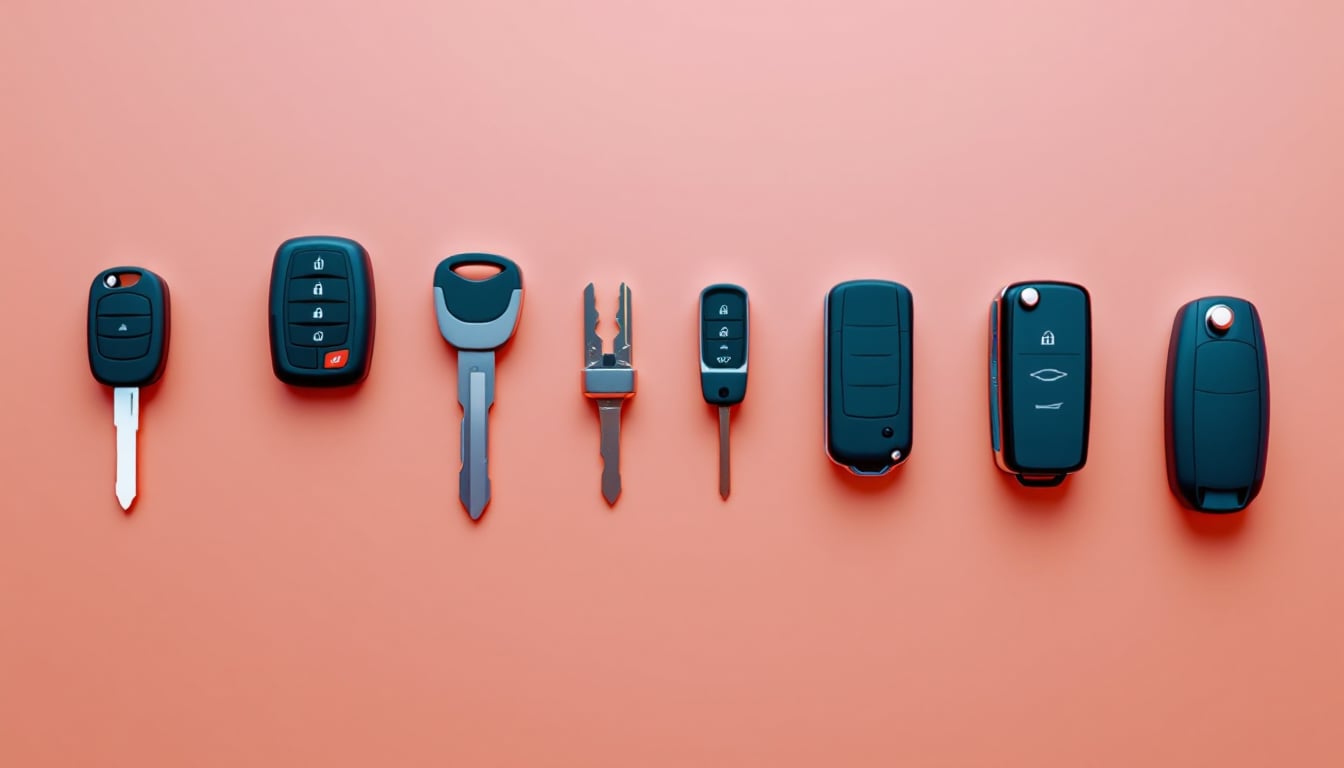
The short answer. As of September 2026, car key replacement sorts into three cost tiers rather than one price. A plain mechanical key with no electronics is the cheapest item in the category — effectively a blank and a cutting charge. Any key carrying an immobilizer chip, which covers transponder, remote-head and flip keys, lands in the low-to-mid hundreds of dollars once cutting and programming are both counted [1] [2]. Proximity smart fobs sit at the top of that normal range and can pass it on premium platforms.
Then comes the part every by-type table leaves out: whether you still hold a working key moves your total further than the key type itself does. A mid-tier key replaced with a spare in hand can cost less than a cheaper key replaced with nothing.
What follows is the breakdown by type, in the order the technology arrived, and a thirty-second test for placing your own key on it.
The seven types, side by side
| Key type | How to recognise it | What the job includes | Relative cost tier |
|---|---|---|---|
| Mechanical, edge-cut | Notches along the edges of the blade, no plastic electronics | Blank plus cutting | Lowest |
| Mechanical, laser-cut | A wavy channel milled into the flat face of the blade | Dearer blank, specialist cutting machine | Low, above edge-cut |
| Transponder key | Plain-looking key with a thicker plastic head hiding a chip | Blank, cutting, immobilizer programming | Mid |
| Remote-head key | Lock and unlock buttons built into the head of the key | Combined hardware unit, cutting, programming | Mid, above plain transponder |
| Flip or switchblade key | Blade folds into the fob body at the press of a button | Fob shell and electronics, cutting, programming | Mid to high |
| Proximity smart fob | Vehicle starts with a push button; the key stays in your pocket | Proximity hardware, emergency blade cut, programming | Highest of the normal range |
| Digital or phone-as-key | A credential in an app or a card, no traditional key at all | Enrolment through the manufacturer account | Usually not a locksmith job |
The tiers are relative to each other, not to a fixed price list. A high-tier key on a mainstream, high-volume vehicle regularly costs less than a mid-tier key on a low-volume import — the pattern the cost-by-make guide maps in detail.
1. The plain mechanical key
No chip, no buttons, no radio. The vehicle does not check the key electronically; if the blade turns the cylinder, the engine starts. This is the pocket-change end of the category, and on the oldest vehicles a hardware store can sometimes do it.
Two things still complicate it. Blanks for genuinely old or low-production vehicles can be scarce, and a worn cylinder often means a key cut from the original code performs better than one copied from a worn key. Both points are covered in the guide to classic and older car key replacement, which is where most of the surprises in this tier actually live.
2. The high-security laser-cut blade
Still purely mechanical in principle, but cut differently. Instead of notches along the edges, a winding channel is milled into the flat faces of the blade. It resists picking and casual duplication, and it needs a milling machine rather than an edge cutter.
That machine is the cost. It runs several times the price of a standard duplicator, so not every shop owns one, and the ones that do price the cut accordingly. If a locksmith says they cannot cut your key even though the vehicle is unremarkable, the blade profile is one of the ordinary explanations — a theme the piece on why key coverage varies between locksmiths takes apart.
3. The transponder key
The pivotal change in this entire subject. A transponder key hides a passive chip in its head; when the key is in the ignition, the vehicle interrogates the chip and refuses to run the engine unless the answer matches. Immobilizers spread to effectively the whole fleet under the federal theft-prevention framework [3], which is why the cost of "a car key" jumped a tier and stayed there.
Practically, it turns one job into two: cut the blade, then have the vehicle accept the chip. The second half is the part people misread as padding, and it is explained mechanically in transponder and smart key programming explained. The dedicated transponder key programming cost guide covers where the programming line itself lands.
4. The remote-head key
A transponder key with the remote built into the plastic head — one object doing three things: turning the cylinder, answering the immobilizer, and transmitting lock, unlock and panic commands.
The integration is what raises the price. Because the blade and the electronics are a single unit, you cannot replace the cheap half on its own. A cracked head or a failed button means buying the transponder as well, and the blade has to be cut into the new unit. Owners of these keys are the group most often surprised that a physical break costs as much as an electronic failure.
5. The flip or switchblade key
Mechanically the same proposition as a remote-head key, with a spring-loaded blade that folds into the fob body. It is a durability story more than a technology story: the hinge and the spring are the parts that fail, and a blade that flops loose or will not latch is the usual reason these come in.
Some flip keys can be rebuilt into a new shell with the original electronics and blade transferred over, which is far cheaper than replacing the key. Whether that is available for your vehicle is worth asking about specifically, because a shop that only sells complete units will not volunteer it.
6. The proximity smart fob
The top of the ordinary range. A proximity fob is a two-way radio system: the vehicle broadcasts continuously, the fob answers when it is close enough, and the doors and the push-button start unlock without the fob ever leaving your pocket.
Three things put it in the highest tier. The hardware is genuinely more complex and the parts channel is tighter — on several manufacturers, proximity fobs remain OEM-only, so the shop buys at dealer parts pricing and passes it through. Programming a proximity system takes longer and demands more current tooling. And nearly every proximity fob contains an emergency blade that has to be cut to your locks, so the cutting line does not disappear; it just moves inside the fob. The comparison in smart key replacement cost versus transponder sets the two tiers against each other directly, and the key fob replacement cost guide breaks the fob case down on its own.
7. Digital keys and phone-as-key
The newest category, and the one most likely to be misunderstood as free. A digital key is a credential rather than an object: your phone, a watch, or a card, authorised against the vehicle through the manufacturer's account system.
Removing the plastic does not remove the enrolment step, and most vehicles that offer a digital key still expect at least one physical key to exist. More importantly for anyone comparing quotes, digital credentials are typically managed by the manufacturer rather than by an independent shop, so a lost phone is usually an app-support or dealer matter and not a locksmith call at all. The digital and EV car key replacement guide sets out where the line currently sits.
The two variables that outrank key type
Whether a working key exists. This is the big one. With a key in hand, the vehicle can be started and its security system opened through the existing key, and the job is hardware plus a routine programming session. With no key at all, the technician has to establish trust with the immobilizer from nothing, which on many modern vehicles means credentialed access to manufacturer security data through the Secure Data Release System operated by the National Automotive Service Task Force [4], plus considerably more time on site. It is the difference between a mid-tier job and a top-tier one on the very same key.
That single fact is also the strongest argument for buying the second key early rather than late — the arithmetic is laid out in spare key cost and when to get one, and it is exactly why buying a used car with only one key deserves a line in your negotiation rather than a shrug.
Which channel you use. A franchised dealer has certain access to the manufacturer's procedure and is occasionally the only route, but the vehicle usually has to come to them, which means a tow when nothing starts. An independent automotive locksmith comes to the vehicle and is generally cheaper for mainstream cars, with coverage as the variable. Locksmithing is skilled local labour with published wage variation between states and metropolitan areas [5], so the same key on the same vehicle is quoted differently in two markets.
Identifying your key in thirty seconds
Work through four questions in order.
Does the car start with a push button? If yes, you have a proximity fob, and the emergency blade folded inside it will still need cutting if the fob is being replaced outright.
Look at the blade edges. Notches along the edges means a standard edge cut. A smooth-edged blade with a wavy channel milled into the flat face means high security, and the shop needs the right machine.
Where are the buttons? In the head of the key itself is a remote-head key. On a separate plastic remote is a plain transponder key plus an independent remote, and those two halves can sometimes be replaced separately.
How old is the vehicle? Roughly speaking, chips became normal through the late 1990s, remote heads through the 2000s, and proximity systems from the mid-2000s onward, brand by brand. The key technology by model year guide places a specific vehicle on that timeline, and the cost by vehicle age guide explains why the oldest and the newest vehicles both cost more than the middle of the fleet.
Turning a type into a quote
Knowing your key type narrows a range; it does not produce a number. Four facts do that: year, make and model, the VIN, whether a working key exists, and whether a blade cut is required. Give all four before dispatch and ask for the total including the trip.
Then ask the two questions that separate a firm quote from an opening bid. Is that the price on the driveway, or can anything be added on arrival? And is the part new, or refurbished and previously paired? The Federal Trade Commission's guidance on hiring a locksmith is the sensible baseline for the rest of the vetting — confirm the business identity, get the price in advance, and treat a number that changes on arrival as a warning [6]. If you already hold a written quote and cannot read it, the anatomy of a car key quote takes a typical one apart line by line.
One last expectation to set: key type also drives the clock, not just the cost. A mechanical copy is minutes and a proximity fob with no working key can occupy most of a visit, which is the subject of how long a locksmith takes to make a car key.
You can also start from geography rather than from the key: browse automotive locksmiths by state and city to see who covers your area, then give two of them the same four facts and compare like for like.
Frequently asked questions
Can you break down car key replacement cost by the different types of keys?
As of September 2026, published consumer guidance groups them into three broad tiers. A plain mechanical key with no electronics is the cheapest thing in the category — a cutting charge and a commodity blank. Anything carrying an immobilizer chip, which means transponder keys, remote-head keys and flip keys, lands in the low-to-mid hundreds once cutting and programming are both counted. Proximity smart fobs sit at the top of the normal range and can pass it on premium platforms. Whether you still hold a working key moves the total more than the key type does.
Which car key type is the most expensive to replace?
A proximity smart fob on a low-volume or premium platform, replaced with no working key present. That combination stacks the most expensive hardware in the category on top of the longest on-site programming session and, on many vehicles, credentialed access to manufacturer security data. The same fob replaced while a working key still exists is a substantially smaller job.
How do I tell which type of key I have?
Look at three things. Does the vehicle start with a push button rather than a turned key? Then you have a proximity fob. Does the metal blade have a wavy channel milled into its flat face rather than notches cut into its edges? That is a high-security laser-cut blade, which needs a different and more expensive cutting machine. Do the lock and unlock buttons sit in the plastic head of the key itself, or on a separate remote? That separates a remote-head key from a plain transponder key with a standalone remote.
Is a laser-cut key more expensive than a regular cut key?
Yes, and for a mechanical reason rather than a pricing convention. A high-security blade is milled on both flat faces by a machine that costs several times what an edge-cutting machine costs, the blanks themselves are dearer, and the cut takes longer. A shop that cuts standard keys all day may not own the machine at all, which is one of the ordinary reasons a locksmith turns a job down.
Does a chipped key always cost more than a non-chipped key?
Almost always, because the chip adds a second job. A key with no transponder is finished when the blade is cut. A chipped key is not usable until the vehicle has electronically accepted it, and that programming step carries its own tooling, software subscriptions and, on some platforms, authorization. Two keys that look identical across a parts counter can differ several-fold once the chip is involved.
Are phone-as-key and digital keys cheaper because there is no hardware?
Not reliably. Removing the plastic does not remove the enrolment step, and on most vehicles that ship with a digital key the manufacturer still expects at least one physical key to exist for the vehicle. Digital credentials are also usually managed through the manufacturer account rather than by an independent shop, so the practical answer is often that this is a dealer or app-support matter rather than a locksmith job at all.
Which key type can an independent automotive locksmith usually handle?
Mechanical, transponder, remote-head and flip keys are routine work across most of the trade, and a large share of proximity fobs are too. Coverage narrows at the newest platforms, the lowest-volume imports and the manufacturers that restrict key registration to an authenticated session. The way to find out is to give a shop your year, make and model before dispatch rather than after.
Sources cited
- AAA — Car key replacement cost guidance (2024).
- Consumer Reports — Key fob and car key replacement guidance (2024).
- NHTSA — Vehicle theft prevention and the federal theft-prevention standard (2024).
- National Automotive Service Task Force — Secure Data Release System & Vehicle Security Professional registry (2024).
- U.S. Bureau of Labor Statistics — Occupational Employment and Wages: Locksmiths and Safe Repairers (49-3071) (2024).
- Federal Trade Commission — Hiring a Locksmith (2023).