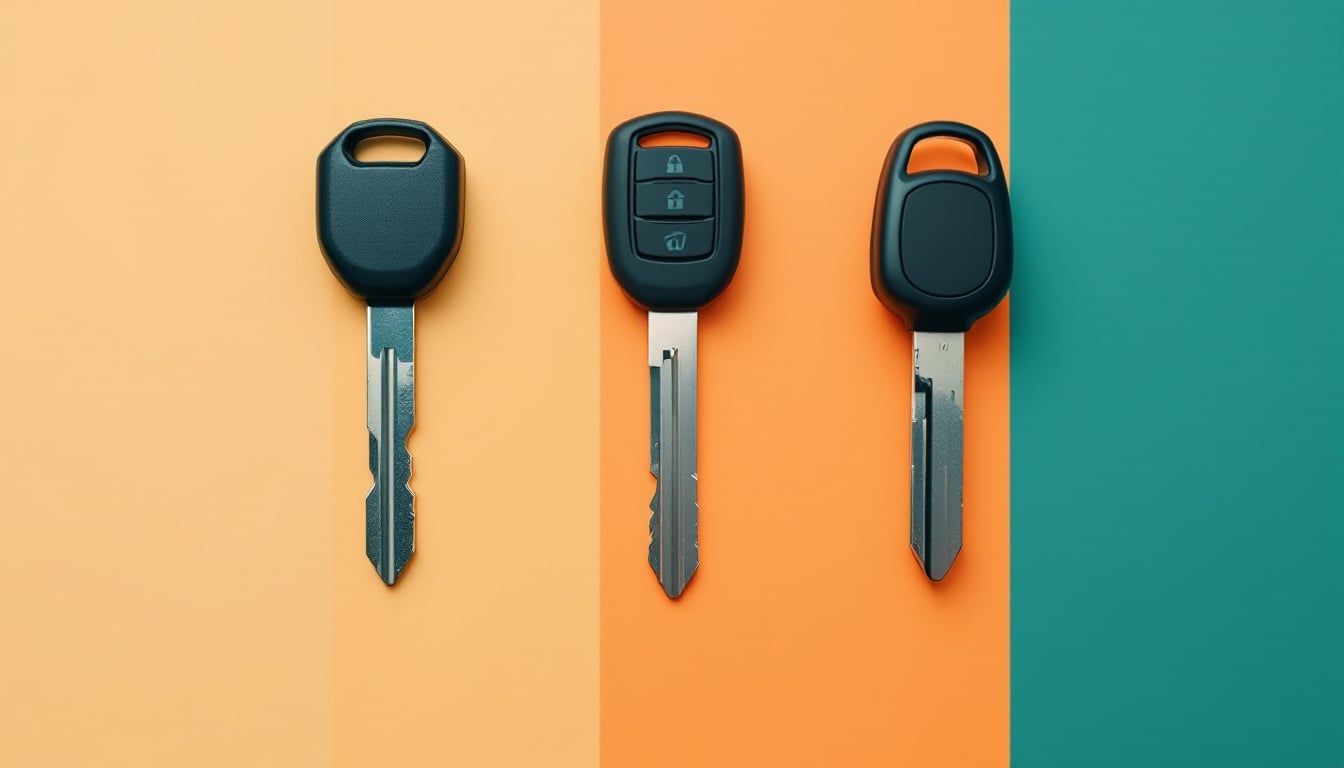
Ask most drivers to guess how a replacement key is priced against vehicle age and you get a straight line: new car expensive, old car cheap. It is a reasonable guess and it is wrong in a specific, expensive way.
As of August 2026 the honest shape is a U. Cost falls as you move back from the newest proximity systems into the transponder and remote-head eras, bottoms out across the enormous middle of the vehicle fleet, and then climbs again once you get old enough that the parts stop being made. The two ends are expensive for opposite reasons — one because the technology is ahead of the aftermarket, the other because the supply chain has moved on — and knowing which end you are near tells you more about your quote than the badge on the hood does. For the brand axis instead, the cost-by-make guide covers the same question sideways.
Why age matters at all: three things change underneath
The key itself. A vehicle's key is a snapshot of what was standard when it was built. Engine immobilizers became effectively universal under the federal theft-prevention framework [2], and they measurably reduced certain categories of theft [3] — but that rollout happened over years, not overnight, so what your vehicle carries depends on when it left the factory. The key technology by model year guide is the fastest way to place yours.
The parts channel. A part is cheap when it is abundant. Abundance follows production volume with a lag: hardware for a platform built in the millions a decade ago is everywhere, hardware for a platform launched last year is not yet, and hardware for a platform discontinued twenty years ago is no longer.
Who is allowed to program it. Older systems were largely open to anyone with the right tool. Newer ones increasingly route key registration through an authenticated session, which in the United States most commonly means credentialed access through the Secure Data Release System operated by the National Automotive Service Task Force [4]. That access is a real, recurring cost to a shop.
Those three curves do not move together, and the U-shape is what you get when you add them up.
The five eras, and what a key costs in each
Model-year boundaries below are approximate and move by manufacturer — some makes adopted a technology years before others, and a few ran two systems side by side across a model line. Treat the bands as a map, not a specification.
| Era band | Typical key | What the job involves | Relative cost tier | The constraint at this point |
|---|---|---|---|---|
| Pre-immobilizer, roughly pre-mid-1990s | Plain mechanical blade | Cut only, no programming | Lowest — if a blank exists | Blank availability, not price |
| Early transponder, roughly late 1990s to mid-2000s | Chip in the key head | Cut plus programming; some accept onboard procedures with two keys present | Low | Occasionally worn locks |
| Remote-head and flip-key, roughly mid-2000s to mid-2010s | Combined blade and remote | Cut plus pairing of the remote and the chip | Low to mid | Hardware costs more than a bare chip key |
| Proximity era, roughly 2010s onward | Push-to-start fob, emergency blade inside | Fob hardware, blade cut, more involved programming | Mid to high | Parts channel and, on some platforms, access |
| Current module-bound era | Proximity fob, key card or phone-as-key on some models | Enrolment against a security module, often an authenticated session | Highest | Manufacturer-controlled authorization |
| Genuinely old, roughly pre-1980s and orphan models | Mechanical, sometimes non-standard | Sourcing or fabricating a blank, cutting to code or to the lock | Rises sharply again | Parts no longer manufactured |
The two extremes are worth stating plainly, because they are the ones that surprise people. A key for a current luxury vehicle is expensive because of hardware and access. A key for a 1968 vehicle is expensive because somebody has to find or make a blank that has not been produced in decades — which is the situation described in classic and older car key replacement.
The bottom of the U is where most vehicles live
The good news for most drivers is that the average vehicle on the road today sits squarely in the cheap middle. Those platforms shipped in volume, aftermarket manufacturers make compatible hardware, tool vendors support the procedures, and enough shops hold the equipment that you can get two quotes without difficulty.
The practical consequence is that a vehicle age which feels "old" to an owner is often the sweet spot commercially. A ten- or twelve-year-old mainstream sedan is usually one of the cheapest vehicles in the country to key, because it is old enough for the aftermarket to have caught up and new enough for the parts to still be in production. Published consumer guidance places routine transponder and smart-key work broadly in the low-to-mid hundreds of dollars [1] [5]; the middle bands sit at the friendly end of that.
Two things can still catch you out there. Whether the key blade is a simple edge cut or a high-security laser cut changes the equipment needed, and that distinction crosses eras rather than following them. And a vehicle whose keys were replaced before may be carrying aftermarket hardware, which matters if you ever need a match — the trade-offs are in OEM versus aftermarket car keys.
The new-vehicle end: access, not just parts
On the newest platforms the interesting cost is no longer the fob. It is permission.
Where a manufacturer requires an authenticated online session to register a key, an independent shop must hold credentialed access before it can do the work at all [4]. That is a subscription and a compliance burden, and it is why two shops in the same town can give you completely different answers about the same three-year-old vehicle: one holds the access for that manufacturer and the other does not. It is not a difference in competence, it is a difference in credentials, and the pattern is set out in why key coverage varies between locksmiths.
The parts side compounds it. Until the aftermarket produces an equivalent fob — which typically takes years after a platform launches — the shop is buying OEM at OEM pricing. So a two-year-old vehicle can genuinely cost more to key than a five-year-old one from the same manufacturer, even though nothing about the procedure got harder.
Newer vehicles are also where the definition of "key" is loosening. Some models now ship with key cards, phone-based digital keys or wearable options alongside a conventional fob, and the enrolment rules for those differ from a plain proximity key. The digital and EV key guide covers what changes when the key is partly an account rather than an object.
The old-vehicle end: the parts run out first
Going the other way, the wall you eventually hit is supply.
Key blanks are manufactured while there is demand. When a model has been off the road long enough, production stops, and what remains circulates through specialist suppliers, old shop stock and the collector trade. At that point price stops tracking difficulty and starts tracking scarcity. A locksmith who can cut your key may still need weeks to source something to cut it on, and a dealer parts counter will often simply return nothing — the scenario described in when the dealer says the key cannot be made anymore.
There is a second, quieter cost at this end: the locks themselves. Wafers wear over decades, and a cylinder that has been opened by the same slightly-worn key for twenty years has worn to match it. A fresh key cut to the original factory code is, in that situation, cut correctly and yet may not turn smoothly. The honest fix is sometimes a lock service alongside the key, which is a second line on the invoice nobody anticipated. If your existing key already needs jiggling or lifting to work, treat that as a warning — is it the key or the ignition walks through separating the two before you spend anything.
Where the curve bends early: low-volume and orphan models
Age is a proxy, and like all proxies it fails in a predictable place. What actually drives the old end of the U is not years elapsed but whether the parts channel still serves your platform — and that depends on how many were built.
A mainstream pickup or sedan produced in the millions keeps its blanks and fobs in production long after the model is discontinued, because there is a large fleet still on the road generating demand. A platform that sold in small numbers does not. The consequence is that a twelve-year-old low-volume import can already sit at the expensive end of the curve while a twenty-five-year-old mainstream truck is still comfortably in the cheap middle.
The same logic applies with extra force to orphan brands — marques that left the market entirely, or models built for one region and imported in small numbers. There, the aftermarket never had a reason to tool up in the first place, so the vehicle effectively starts life near the old end of the curve and stays there.
If your vehicle is unusual rather than merely old, ask about parts availability first and treat the model year as secondary. It is the more reliable question.
What age does not change
Three things stay constant across every band, and a quote that blames your model year for them deserves a second call.
Whether you still have a working key remains the single largest cost driver at any age. Adding a key to a cooperative vehicle is a different job from starting one that has no key at all, and that gap dwarfs most era effects.
Documentation is required regardless of era. A legitimate shop asks you to prove the vehicle is yours before it makes anything, on a 1994 pickup exactly as on a 2026 SUV, and one that offers to skip it has told you something important [6].
And the second-key discount is universal. Whatever era your vehicle is from, a second key programmed during the same visit is the cheapest key you will ever buy, because the trip and the programming session are already paid for. That arithmetic is laid out in the spare key economics, and it matters most at the two expensive ends of the U — precisely where owners are most tempted to defer it.
Using your model year to get a better quote
Knowing your band changes the questions you ask.
Middle bands. Ask for an all-in total including the trip, and get two quotes. Competition is real here and the spread between shops is often larger than the spread between eras.
New end. Ask the coverage question before the price question: do you hold the access for this manufacturer and this year? A shop that answers precisely — rather than "we can do anything" — is the one to book. If the fob itself is what you are pricing, the key fob replacement cost guide breaks the fob job into its four variants.
Old end. Ask about the blank before anything else. If it exists, the rest is straightforward; if it does not, the conversation is about sourcing and timelines rather than price. Ask too whether the locks should be inspected while the technician is there.
In every band the same four facts turn an estimate into a quote: year, make and model; the VIN; whether a working key exists; and whether a blade needs cutting. Add one more for the two ends — ask explicitly whether this specific year is one they cover, before anyone is dispatched.
To see which shops operate near you before you start calling, browse automotive locksmiths by state and city or use the directory search.
Frequently asked questions
Is a key for an older car always cheaper?
Up to a point. Cost falls as you move back from the newest proximity systems into the transponder and remote-head eras, where parts are plentiful and aftermarket tooling coverage is deep. Go back far enough, though, and it rises again — blanks for long-discontinued models become scarce, the lock hardware is worn, and the work turns into a specialist job rather than a routine one.
Which model years are cheapest to get a key made for?
As a rule the middle of a vehicle lifetime, broadly the transponder and remote-head eras of the late 1990s through the mid-2010s. Those platforms shipped in enormous numbers, the aftermarket makes compatible hardware, and the programming procedures are widely supported. The exact boundaries move by manufacturer, so year alone is a guide rather than a rule.
Why are keys for brand-new vehicles so expensive?
Three reasons stack. The hardware is a proximity fob rather than a chip in a plastic head. The aftermarket has not yet produced an equivalent part, so the shop is buying at dealer pricing. And a growing share of new platforms bind the key to a security module, which means the shop needs credentialed access to manufacturer data before it can enrol anything.
Does the age of the locks matter as well as the age of the key?
It does, and it is the part people forget. Lock wafers wear over decades, and a worn cylinder can be shaped enough by an old key that a fresh key cut to the original factory code will not turn smoothly. On a high-mileage older vehicle that can turn a simple key job into a key job plus a lock repair.
What does an all-keys-lost job do to the age effect?
It amplifies both ends. On a newer vehicle, having no working key means credentialed security access and considerably more time on site. On a very old one it can mean deriving the cuts from a code or from the locks themselves, and hoping a blank still exists. The middle bands absorb an all-keys-lost job far better than either end does.
At what age should I stop assuming a locksmith can help?
There is no age at which that becomes true, but there are two zones where you should ask before assuming. Very new platforms may need manufacturer-level access that not every shop holds, and very old vehicles may need parts that no longer exist. In both cases the question to ask on the phone is about your specific year and model, not about the trade in general.
Does the vehicle age change how long the job takes?
Usually yes. A middle-era transponder key with a working spare present is often quick. Newer platforms can require an authorization step that adds waiting time, and very old vehicles can require sourcing a blank before anyone can start, which is measured in days rather than minutes.
Sources cited
- AAA — Car key replacement cost guidance (2024).
- NHTSA — Vehicle theft prevention and the federal theft-prevention standard (2024).
- Insurance Institute for Highway Safety — Vehicle theft and anti-theft technology (2024).
- National Automotive Service Task Force — Secure Data Release System & Vehicle Security Professional registry (2024).
- Consumer Reports — Car maintenance and ownership-cost guidance (2024).
- Federal Trade Commission — Hiring a Locksmith (2023).