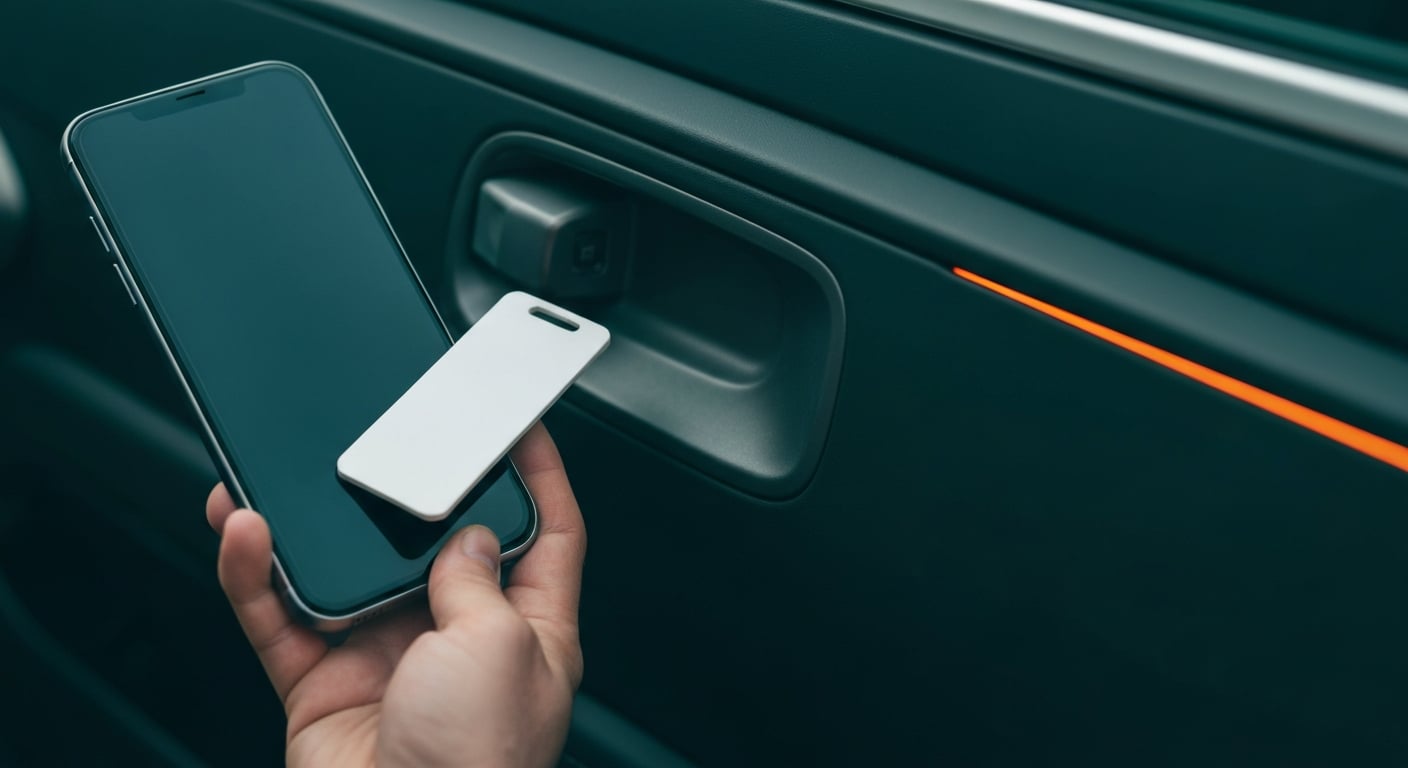
For a century, "I lost my key" meant a physical object was missing. On a growing share of new vehicles — electric models especially — that sentence can mean something entirely different: a phone is dead, a credential was revoked, an account is locked, or a card is sitting in a jacket at home. The object may not exist at all.
That shift changes who can help you. A locksmith cuts and programs keys; they do not issue credentials in a manufacturer's account system. As of July 2026, understanding which kind of key your vehicle actually uses — and what its backup path is — is the difference between a ten-minute inconvenience and a genuinely stranded afternoon.
The four credential types on modern vehicles
Most vehicles built in the last few years use one or more of these:
1. Proximity fob. The familiar push-to-start fob. Physical, battery-powered, replaceable by a properly equipped automotive locksmith. We cover its economics in why smart keys cost more.
2. Key card. A slim card, typically held against a pillar or console reader. Common on EV-first platforms. Cheap to replace relative to a fob, easy to keep in a wallet, and easy to forget on a kitchen counter.
3. Phone-as-key. A credential stored securely on a phone or watch and presented over short-range wireless. Cross-brand interoperability work is coordinated through the Car Connectivity Consortium, which publishes the Digital Key specification the industry has converged on [1]. This is why a modern phone can increasingly act as a key across several manufacturers rather than one.
4. Account-based shared access. Not a key at all in the traditional sense: a permission granted from the owner's manufacturer account to another person's device, revocable remotely.
Many vehicles ship with a mix — for example a card plus phone key, with an optional conventional fob. The mix is what determines your recovery options.
What actually fails, and who fixes it
| Failure | What is really wrong | Who resolves it |
|---|---|---|
| Phone battery dead | No credential presented | You — use card, backup fob, or phone reserve power |
| Phone lost or stolen | Credential still valid on a device you do not have | You — revoke from the manufacturer account, then re-pair |
| Key card lost | Physical credential missing | Manufacturer or authorized service; a spare card covers it |
| Card demagnetized or cracked | Physical damage | Replace the card |
| Account locked or email inaccessible | You cannot manage credentials | Manufacturer support with identity verification |
| Fob battery dead | Passive-entry range lost | You — coin cell, then the vehicle's backup coupling method |
| Fob lost, no spare | All keys lost on a proximity platform | Automotive locksmith or dealer, per platform |
| Vehicle will not detect any credential | Vehicle-side receiver or module fault | Diagnostic work, not a new key |
The important pattern: the top half of that table is not locksmith work. It is account and identity work, handled by the manufacturer. The bottom half is conventional key work, and there our all keys lost walkthrough applies unchanged.
Why the security model changed
Digital keys are not a convenience feature bolted onto an old system — they are a different security architecture. Traditional immobilizers, which spread under federal theft-prevention pressure [3], put the trust decision inside the car: a chip answers a challenge, a module says yes or no. Digital keys move part of that decision into a credential issued and revocable from outside the vehicle.
There are real advantages. A lost phone key can be revoked in seconds, where a lost fob stays valid until someone reprograms the car. Modern implementations also address distance-based attacks that the safety-research community has documented against older passive-entry systems [4], and vehicle theft remains a heavily tracked problem that keeps this arms race moving [5].
There is also a real trade-off: your access now depends on an account you do not control, and account recovery is an identity process with its own timelines. That is the part owners consistently under-plan for.
The five-minute preparation that prevents most digital-key emergencies
None of this requires expertise. Do it once:
- Locate your physical backup and confirm it works. Find the card or spare fob, then actually use it to unlock and start the vehicle. An untested backup is a hypothesis.
- Keep the backup somewhere separate from your phone. A card in your wallet is useless if wallet and phone live in the same pocket that goes missing together.
- Verify you can log into the manufacturer account. Not the app on your unlocked phone — a real login with the password, on a different device. If the recovery email is an address you no longer read, fix that today.
- Learn your vehicle's dead-battery procedure. Nearly every push-to-start and digital-key vehicle has one: a marked spot to hold the credential against, a hidden card reader, or a slot. Look it up now, not at 11pm.
- Add a second authorized person. If your account and phone are both unavailable, someone else being able to open the car is worth a great deal.
Owners of fob-only vehicles have a simpler version of the same rule — get a spare while the first key works, because the alternative is the most expensive scenario in the trade. That is covered in our cost by make guide.
Shared keys, valets and family: a practical policy
The most genuinely useful thing digital keys added is not the phone — it is the ability to grant and revoke access to someone else without handing over an object. That capability quietly creates a small administrative job most owners never do.
Grant narrowly. Most implementations let you issue a shared key with limits — a time window, restricted functions, or driving-mode constraints. A contractor who needs the car for an afternoon does not need indefinite access.
Audit periodically. Once or twice a year, open the account and look at the list of authorized devices and shared keys. Expect to find at least one entry you had forgotten: an old phone, a former housemate, a dealer loaner pairing, a family member who moved out. Each one is a working credential.
Remember valet and service pairings. Some vehicles create a temporary credential during service or valet use. Most expire; not all do. Checking after a service visit takes seconds.
Have a fallback that does not depend on you. If you are the only person who can authorize access and you are unreachable — travelling, hospitalized, phone lost abroad — the vehicle is effectively locked to everyone. A second authorized person is worth setting up before you need it.
Do not share account credentials as a workaround. Handing over your account password to give someone access substitutes an auditable, revocable credential for an unauditable one, and typically hands over location history and payment methods along with it. Use the sharing mechanism the platform provides.
None of this is difficult. It is simply a category of ownership task that did not exist when keys were objects, and which nothing in the buying process prompts you to do.
Buying, selling and shared access
Digital keys create a transfer problem that physical keys do not. When you hand someone a fob, access moves with the object. When access is an account permission, handing over the car changes nothing about who can open it.
Before selling or trading a vehicle with digital keys:
- Remove every paired device from the account, including old phones you no longer use
- Revoke every shared key issued to family, friends or valets
- Perform any manufacturer-documented factory reset for the infotainment and access system
- Hand over every physical card, fob and mechanical blade, and say how many exist
- Confirm with the buyer that only their credentials remain
The same list applies in reverse when you buy. A used vehicle whose previous owner's phone still opens it is a genuine security problem, and it is invisible unless someone checks.
Where an automotive locksmith still fits
Plenty of it, in fact. Digital-key vehicles almost all retain a mechanical path — an emergency blade inside a fob, a hidden lock cylinder under a door-handle cap — and they still have conventional fobs on most platforms. An automotive locksmith is the right call for a lockout, a broken emergency blade, a conventional backup fob, or an all-keys-lost recovery on a platform that supports it. Where authenticated manufacturer data is required, credentialed technicians access it through the established framework [6].
If you are sourcing any physical fob yourself, match the equipment authorization identifier printed on your existing unit using the FCC's public lookup rather than matching photographs [2] — and confirm the shop will program a customer-supplied part before you buy.
When you do call, the usual consumer guidance applies: get the total price and the business's credentials in writing before work begins [7]. Our seven-point verification check is the short version. To compare shops that handle late-model and EV platforms, get matched sends your vehicle details once, or browse the directory by state — California and Washington among them.
Frequently asked questions
What is a digital car key?
It is vehicle access delivered through a phone, watch or card rather than a traditional fob — typically using short-range wireless standards so the car recognizes the device as an authorized credential. Industry work on interoperable digital keys is coordinated through the Car Connectivity Consortium, which is why the same phone can increasingly work across brands.
If my phone dies, am I locked out of my car?
Usually not immediately. Most implementations keep a physical backup — a key card, a conventional fob, or a mechanical blade — and some phones retain enough reserve power to present a stored key after the screen goes dark. The real risk is having no backup credential at all, which is a planning failure rather than a technical one.
Can a locksmith replace a digital key?
Not in the same way they replace a fob. A digital credential is issued by the manufacturer's system and tied to an account, so restoring it is usually an account and identity process. A locksmith can still help with the physical side — an emergency blade, a lockout, or a conventional backup fob where the platform supports one.
What happens to digital keys when I sell the car?
They must be revoked deliberately. Removing your app is not the same as removing your access. Before transferring a vehicle, remove every paired device and shared key from the manufacturer account and confirm with the buyer that only their credentials remain — then hand over every physical card and fob.
Are EV keys more expensive to replace than gas-car keys?
Not because the vehicle is electric. What matters is the credential type the manufacturer chose. A slim key card is often inexpensive; a full proximity fob for the same vehicle is priced like any other smart key.
What is the single best precaution for a digital-key vehicle?
Keep a physical backup you do not carry in the same pocket as your phone — a spare card in your wallet or a conventional fob at home — and make sure at least one other trusted person can restore access if your phone and account are both unavailable.
Sources cited
- Car Connectivity Consortium — Digital Key specification and interoperability work (2024).
- Federal Communications Commission — Equipment authorization and FCC ID lookup (2024).
- NHTSA — Vehicle theft prevention and the federal theft-prevention standard (2024).
- Insurance Institute for Highway Safety — Vehicle theft, relay attacks and anti-theft technology (2024).
- National Insurance Crime Bureau — Vehicle theft trends and prevention resources (2024).
- National Automotive Service Task Force — Secure Data Release System & Vehicle Security Professional registry (2024).
- Federal Trade Commission — Hiring a Locksmith (2023).