When a locksmith quotes an "all keys lost" job at several times the price of a spare key, the reaction is usually the same: it is the same key, so why is it a different price? The answer is that it is not the same job at all. Cutting a key that fits the door is trivial. Convincing a modern vehicle's security system to accept a key it has never met, when there is no existing key to vouch for it, is the actual work — and it is deliberately hard, because the alternative would be a world where anyone with a laptop could start any car.
This guide walks through what happens between the phone call and the moment the engine turns over. As of July 2026, understanding the sequence is the fastest way to tell a competent shop from a bad one, because the steps a legitimate technician takes are specific and observable. If you are in the situation right now rather than researching it, start with our practical checklist for losing your only car key.
Why "no working key" changes everything
Nearly every vehicle sold in the United States for decades has shipped with an engine immobilizer: a security module that will not permit the engine to run unless it recognizes an authorized key. Their spread is directly tied to federal theft-prevention policy [2], and the effect on theft rates for equipped vehicles has been documented repeatedly [3]. Vehicle theft remains a significant and closely tracked problem [4], which is why manufacturers have kept tightening key authorization rather than loosening it.
The immobilizer maintains a list of keys it trusts. Adding a key when a trusted one is present is, conceptually, an introduction: the known key is in the ignition or the cabin, the system is placed into a learn mode, and the new key is enrolled. Remove the trusted key from that picture and there is no one to make the introduction. The technician must instead prove to the module, through a documented and often authenticated procedure, that they are authorized to reset or extend its trust list.
That is the entire cost story in one paragraph. Everything else — the tooling, the credentials, the time on site — follows from it.
The five stages of a legitimate all-keys-lost job
Stage 1: Vehicle identification
Nothing begins before the year, make, model and VIN are confirmed. The VIN determines the key type, the immobilizer generation, the blank or fob part number, and the procedure class. A shop that quotes a firm all-keys-lost price without asking for a VIN is quoting a guess.
Stage 2: Proof of ownership
This step is not bureaucratic theater and you should be suspicious if it is skipped. Expect to present photo ID plus a document connecting you to the vehicle — registration, title, or an insurance card matching the VIN. Where a technician is obtaining manufacturer security data, the credentialing framework itself requires that the requester document a legitimate business need and the vehicle owner's authorization [1]. Professional bodies in the trade treat ownership verification as a baseline standard of practice [6].
If you are having a key made for a vehicle that is not registered to you — a recently purchased car, an estate vehicle, a company fleet unit — say so up front and bring the paperwork. It is a solvable problem when disclosed and a dead end when discovered halfway through.
Stage 3: Mechanical access and key cutting
The technician needs a key that physically fits. Depending on the vehicle this is done by decoding the lock cylinder, by cutting to code derived from the VIN through an authorized channel, or — on push-to-start vehicles with no cylinder in the dash — by producing the emergency blade inside the fob. On proximity-key vehicles the mechanical side is often the smallest part of the job.
Stage 4: Establishing immobilizer trust
This is the stage that separates platforms. Broadly, three paths exist:
- On-board procedures. Some older and simpler systems accept a documented sequence performed at the vehicle, sometimes with a security PIN retrieved from the VIN.
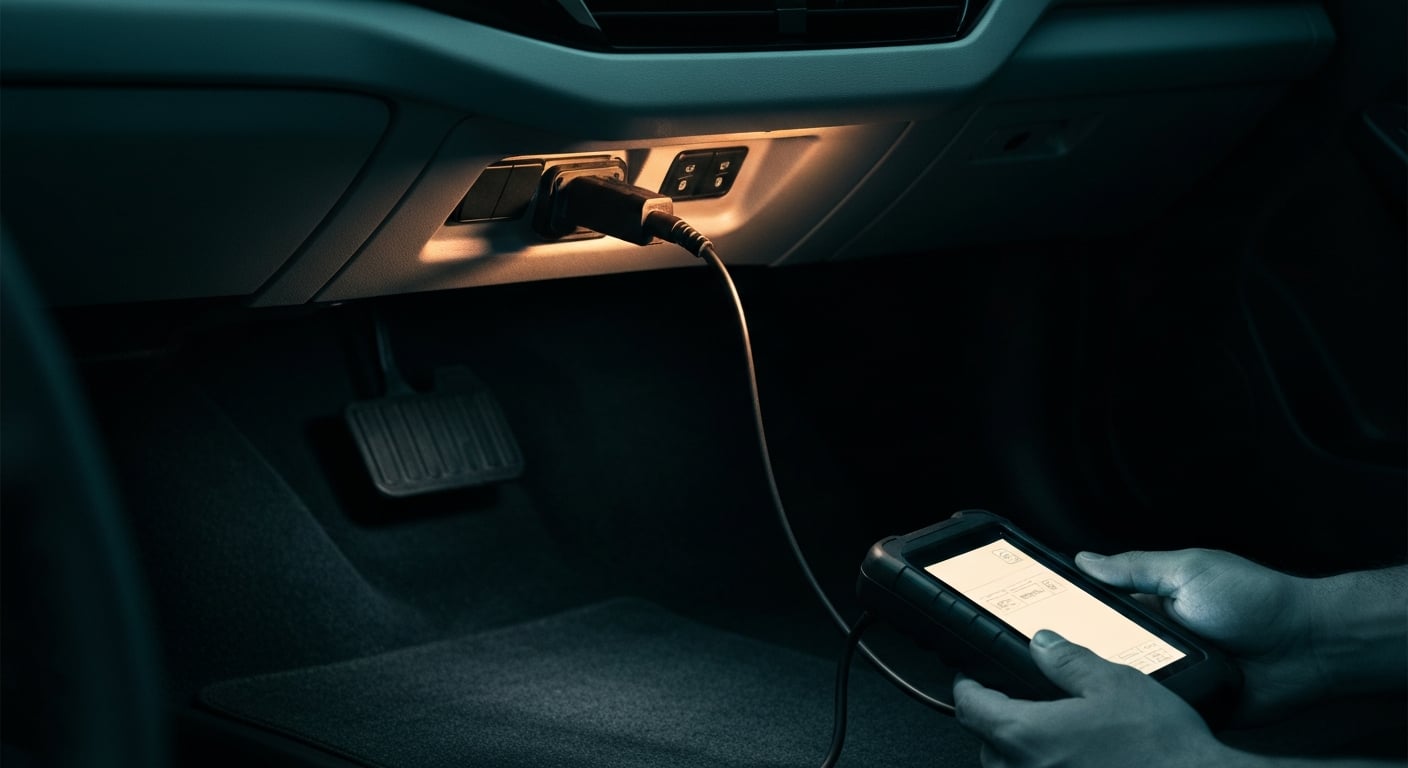
- Diagnostic-tool programming. The technician connects to the vehicle's diagnostic port and uses professional tooling to reset or extend the key list. Many mainstream vehicles fall here.
- Authenticated manufacturer access. On a growing set of platforms, the security module will only accept a new key after an authenticated online session tied to a registered technician. In the U.S. this most commonly runs through the Secure Data Release System, and the technician has to hold current Vehicle Security Professional credentials to use it [1].
A fourth path exists on some vehicles — reading data directly from the security module on the bench — but it is specialist work, it is not universally supported, and it is not something to expect from a general call-out.
Stage 5: Verification and cleanup
The job is not finished when the engine starts. A careful technician confirms that every function works — start, remote lock and unlock, panic, trunk release, push-to-start proximity detection — and confirms what happened to previously stored keys. On many all-keys-lost procedures the module's entire key list is erased and rebuilt, which is the correct security outcome: if a key is genuinely lost, you want it de-authorized.
Why the security waiting periods exist
Owners are frequently surprised that a technician is sitting in the car doing apparently nothing for a stretch of time. On several platforms the immobilizer imposes a mandatory delay during a security-sensitive procedure — a deliberate anti-attack measure, since it makes brute-force attempts impractically slow.
No tool shortens that delay. It is part of the vehicle's design, and a shop that claims otherwise is either mistaken or describing a method you do not want performed on your car. Budget for it when planning your day.
What this means for cost and scheduling
Published consumer guidance places modern key replacement broadly in the low-to-mid hundreds of dollars, with all-keys-lost work on premium platforms reaching the top of the range and beyond [7]. The drivers, in order:
| Factor | Effect on an all-keys-lost job |
|---|---|
| Programming path required | On-board is cheapest; authenticated manufacturer access is the most expensive |
| Key hardware | A bare transponder key is a fraction of a proximity fob |
| Mandatory security delay | Adds fixed on-site time regardless of skill |
| Number of keys made | A second key programmed in the same visit is far cheaper than a separate later call |
| Location and hour | Travel radius and after-hours dispatch carry their own charges |
| Ownership documentation | Missing paperwork can stop the job entirely |
The most useful money-saving decision available to you is on row four: have two keys made while the technician is already there and the module is already open. The marginal cost of the second key is small compared with paying for a whole new visit later — and it converts every future key event from an all-keys-lost job back into an ordinary spare-key job. Our cost by make guide shows how much that difference is worth on your brand.
What you can do while you wait
Once a technician is dispatched, there are five things that measurably shorten the visit — and every one of them is free:
- Assemble the documents now. Photo ID plus registration, title or an insurance card matching the VIN. If any of it is inside the locked vehicle, say so on the phone rather than at the kerb.
- Read out the VIN when you book. It is visible through the base of the windshield on the driver's side and on the door-jamb sticker. Giving it up front lets the shop confirm the part is on the van before leaving.
- Confirm physical access. Gated lots, underground garages, tow yards and apartment complexes all need arranging in advance. A technician who cannot reach the vehicle has burned the trip.
- Decide about the spare before they arrive. You will be asked. Deciding in advance means you are answering a planned question rather than an upsell in the moment.
- Have the person with authority present. Whoever's name is on the registration should be there or reachable, because that is who the ownership check runs against.
None of this speeds up the programming itself. All of it removes the stalls around it, which in practice is where lost time actually accumulates.
The two-key arithmetic
The most common regret after an all-keys-lost job is declining the second key to keep the invoice down. It is worth doing the arithmetic explicitly, because the numbers are lopsided.
An all-keys-lost job charges for identification, ownership verification, security access, tooling time and the mandatory delay — plus the key hardware. Almost all of that is a fixed setup cost incurred once. When the technician programs a second key in the same session, the setup is already paid for; you are adding hardware and a short increment of enrollment time.
The saving compounds in a second way that people miss. Owning two keys does not merely give you a spare — it permanently downgrades your future risk class. Lose one key when you hold two, and the next job is an ordinary add-a-key visit at the bottom of the price range. Lose your only key, and you are back in this article. One decision at the end of a visit you are already paying for changes which of those two futures you are living in. The relative cost of each on your specific brand is mapped in our cost by make guide.
Choosing who does the work
The Federal Trade Commission's locksmith guidance is directly applicable here: get the total price and the business's credentials in writing before work begins, and treat a quote that balloons on arrival as a reason to stop [5]. Three questions worth asking, in order:
- "Have you done this year, make and model all-keys-lost before?" — capability is platform-specific.
- "What documentation do you need from me?" — a shop that needs nothing is a problem.
- "Is the quoted price all-in, including the second key if I want one?"
To compare answers without making five separate calls, you can get matched with screened automotive locksmiths by describing the vehicle once, or browse the directory by state and city. Every listing on KeyAtlas is sourced and attributed; how that works is documented on our data and attribution page.
Frequently asked questions
What does "all keys lost" actually mean?
It means the vehicle has no working key of any kind — not a spare in a drawer, not a valet key, nothing that will start the engine. That distinction matters because adding a key to a car that already has one is a comparatively quick procedure, while an all-keys-lost job requires establishing the vehicle security system's trust from scratch.
What proof of ownership will I be asked for?
Expect to show a government-issued photo ID plus a document tying you to the vehicle — registration, title, or an insurance card matching the VIN. A legitimate shop will ask. If nobody asks, that is a warning sign, not a convenience.
Can any locksmith do an all-keys-lost job on any car?
No. Capability varies by platform and by shop. Some vehicles are routine, some require credentialed access to manufacturer security data, and a minority still route back to a franchised dealer. Ask specifically whether the shop has done your year, make and model before, not whether they "do all cars."
Will my old keys still work after a new one is programmed?
Not always, and often you should not want them to. Many all-keys-lost procedures erase every previously stored key from the immobilizer, which is the security-correct outcome when a key is genuinely lost or stolen. Ask the shop to confirm whether old keys are being purged.
How long does an all-keys-lost job take?
Commonly one to a few hours on site once a technician arrives, depending on the platform. Some systems impose a mandatory security waiting period during programming that no tool can shorten, and a few require ordering hardware first.
Is it cheaper to have the car towed to a dealer?
Usually not. A tow is a real cost, and the dealer route typically adds a parts-order and scheduling wait. Mobile service is generally cheaper and faster for mainstream vehicles; the exception is the small set of platforms where only the dealer can authorize a new key.
Sources cited
- National Automotive Service Task Force — Secure Data Release System & Vehicle Security Professional registry (2024).
- NHTSA — Vehicle theft prevention and the federal theft-prevention standard (2024).
- Insurance Institute for Highway Safety — Vehicle theft and anti-theft technology (2024).
- National Insurance Crime Bureau — Vehicle theft trends and prevention resources (2024).
- Federal Trade Commission — Hiring a Locksmith (2023).
- ALOA Security Professionals Association — Professional standards and credentialing for locksmiths (2024).
- AAA — Car key replacement cost guidance (2024).