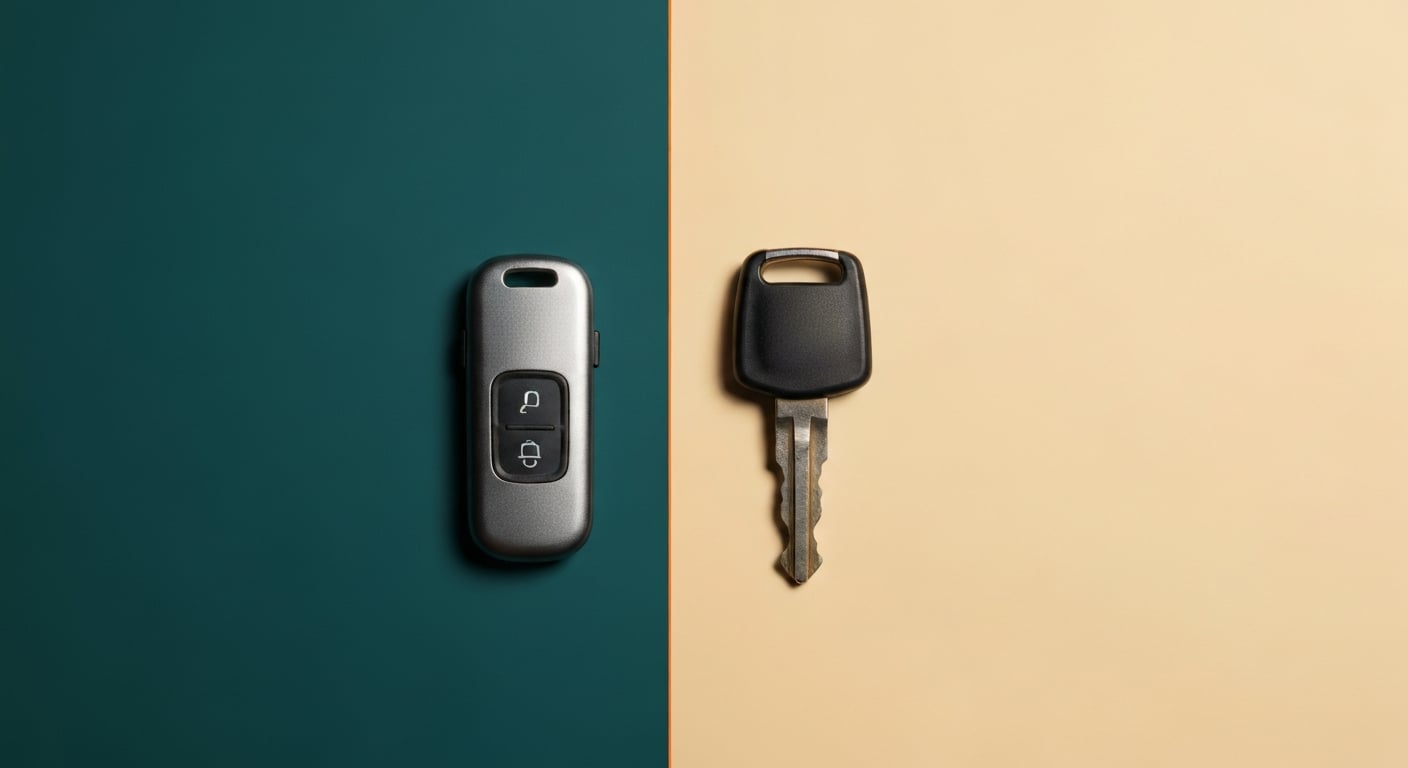
Short answer, as of July 2026: replacing a push-to-start smart key typically costs several times what replacing a basic transponder key costs. Published consumer guidance places modern smart-key work toward the upper half of the car-key replacement range, where a plain chipped key sits near the bottom [1] [2]. On premium platforms with no working key, the figure can reach four digits.
From the driver's seat the two devices do the same thing: you approach, you get in, the car starts. So the price gap looks like markup. It is not. It decomposes into four specific components, and separating them tells you exactly where you can save money and where you cannot.
Component 1: the fob is a manufactured electronic device
A transponder key is a cut piece of metal with a passive chip in the head. The chip has no battery — the car energizes it at a range of a few centimetres. Manufacturing volume is enormous and the blanks are commodities.
A proximity fob is an entirely different product: a battery-powered two-way radio with encrypted electronics, an antenna tuned to the vehicle's system, tactile buttons, a moulded housing, and a mechanical emergency blade hidden inside for the door lock. It is produced in far smaller volumes, often per-platform. Every fob sold in the U.S. carries an equipment authorization identifier, and the FCC's public lookup for those IDs is the reliable way to confirm which unit matches your vehicle [3] — a useful check before buying anything online.
Hardware alone accounts for a large share of the gap, before a technician touches the car.
Component 2: rolling-code security raises the programming bar
Passive transponder chips answer a challenge with a fixed identifier — the mechanism explained in our guide to transponder and smart-key programming. Proximity systems use encrypted, rolling-code communication designed to defeat replay attacks — a direct response to the theft-prevention pressure that made immobilizers universal in the first place [4], and to newer attack methods including relay techniques that safety researchers track closely [5].
Practically: the enrollment procedure for a proximity key is a more guarded operation than adding a chip key. More platforms gate it behind a security code or an authenticated session, which brings us to the third component.
Component 3: programming access
On a meaningful and growing share of push-to-start vehicles, the security module will only accept a new key after an authenticated session with the manufacturer. In the United States, independent technicians most commonly reach that through the Secure Data Release System, which requires current Vehicle Security Professional credentials and documentation of both the business and the owner's authorization [6].
That access has a cost — credentials, subscriptions, per-event fees — and it is the reason the locksmith-versus-dealer saving narrows on premium platforms. On a mainstream vehicle the independent route usually wins on both price and speed; on a low-volume European proximity system, both parties may be performing substantially the same authenticated procedure. Our dealer vs locksmith comparison works through where the line falls.
Component 4: diagnosis, because "the key failed" often is not true
Smart-key systems have more failure modes than chip keys, and several of them are not the key. A competent shop diagnoses before selling:
| Symptom | Most likely cause | Cheapest first step |
|---|---|---|
| Car does not detect fob at all | Fob coin-cell battery | Replace the cell |
| Detects intermittently | Weak battery, worn housing, or antenna fault | Test with the spare |
| Works only when held to the start button | Fob battery depleted; backup coupling in use | Replace the cell |
| Remote buttons dead, push-start still works | Button contacts or board damage | Inspect housing |
| Neither fob works | Vehicle-side receiver or module | Diagnostic, not a new key |
| Fob fell in water | Corrosion; may be recoverable | Dry and inspect before buying |
That table is the money-saving part of this article. A large fraction of "I need a new smart key" calls resolve to a coin cell. Our key fob replacement guide walks the battery-first path in detail, and if both fobs behave identically the problem is almost certainly the car rather than either key.
The vocabulary, so you can read a quote
Shops and parts listings use several names for overlapping things, and the ambiguity is where quote comparisons go wrong. In rough order of cost:
Transponder key. Cut metal blade, plastic head, passive chip. No battery, no buttons. Cheapest electronic key.
Remote head key. The same thing with lock/unlock buttons built into the head, so it also contains a battery and a transmitter. More expensive than a bare transponder key, less than a proximity fob.
Flip key. A remote head key whose blade folds into the housing. The folding mechanism is a convenience feature, not a security one; price sits alongside remote head keys.
Fob with integrated key. A fob-shaped unit you insert into a dash receptacle and turn. Priced closer to proximity hardware because the electronics and the key are a single part.
Proximity / smart key. Buttonless operation with the fob in your pocket, push-button start, encrypted rolling-code communication, emergency blade hidden inside. The most expensive category.
Key card. A slim card presented to a reader, common on EV-first platforms. Often the cheapest credential on an otherwise expensive vehicle.
When two quotes differ sharply, check that both are pricing the same item on this list before concluding one shop is overcharging. "Key fob" in an advertisement can mean any of the middle four.
Why passive entry adds a security chore
One consequence of proximity keys that has nothing to do with cost but everything to do with owning one: because the fob broadcasts to the car without you doing anything, it can be reached without you doing anything.
Safety researchers have documented relay-style techniques against passive-entry systems, in which the fob's signal is captured near the house and repeated near the vehicle [5]. Manufacturers have responded with motion-sensing fobs that go dormant when still, distance-bounding measures, and driver-selectable sleep modes.
Two practical habits follow. First, if your fob has a sleep function or a motion timeout, use it. Second, do not store keys near the front door of a house — the wall between a hallway table and a driveway is not much of an obstacle. Neither habit costs anything, and both address a risk class that simply does not exist with a passive transponder key sitting in a drawer.
Where the two paths diverge most: no working key
Everything above assumes you still have one working key. Remove it and the gap widens sharply, because the all-keys-lost scenario is precisely where proximity platforms are most demanding — no existing key to vouch for the new one, an authenticated procedure, and on many vehicles a mandatory security delay that no tool shortens. We cover the full sequence in all keys lost.
This produces the single most consequential piece of advice for anyone driving a push-to-start vehicle with exactly one fob: get a second one made now, while the first still works. It costs a fraction of the all-keys-lost figure, and it permanently converts your worst-case key event into an ordinary one. Where your specific brand sits on that scale is mapped in our cost by make guide.
What you can actually control
Ranked by how much money is on the table:
- Have a spare made before you need one. The largest single saving available.
- Make two keys in one visit if you are already paying for a technician. The setup cost is sunk; the second key is marginal.
- Rule out the battery and the vehicle side before buying hardware. Diagnosis is cheaper than parts.
- Compare two or three quotes with the same scope. All-in, including any service-call fee.
- Match the FCC ID, not the photograph, if you source your own part — and confirm first that a shop will program a customer-supplied fob at all [3].
A sixth item belongs on that list for anyone who has just bought a used car: count the keys before you need them. Used vehicles are routinely sold with a single fob, because the second one went missing somewhere in the previous ownership and nobody mentioned it. The first time most owners discover this is the day the one fob fails, at which point they are in the all-keys-lost column rather than the spare-key column. Checking takes ten seconds at handover and is worth doing on any used purchase, private or dealer.
What you cannot control: the fob's manufacturing cost, your platform's programming class, and the security delay. Any shop promising to beat those is describing a method you should ask hard questions about. The Federal Trade Commission's baseline still applies — get the total price and the business's credentials in writing before work begins [7], and our seven-point verification check covers the rest.
Getting a firm quote on a proximity key
Year, make, model, VIN, and whether you have a working fob. Those four facts let a competent shop identify the exact part number and programming class and quote flat rather than in a range.
To collect several comparable quotes at once, get matched sends the details to screened automotive locksmiths in one step. You can also browse listings by state and city — for example New York, Washington or Florida — or read the broader car key replacement cost guide for how all four key types compare.
Frequently asked questions
How much more does a smart key cost than a transponder key?
As a rule of thumb, several times more. Published consumer guidance puts modern smart-key replacement toward the upper half of the car-key cost range as of July 2026, where a basic transponder key sits near the bottom. The multiple is driven mostly by the fob hardware and the programming class, not by the labor rate.
Why is the fob itself so expensive?
A proximity fob is an active radio device with its own battery, encrypted rolling-code electronics, an antenna, buttons and a hidden emergency blade — manufactured in far smaller volumes than a plain key blank. It is a component, not a piece of cut metal.
Can I buy a used smart key online and have it programmed?
Sometimes, but many used fobs are already paired to another vehicle and will not enroll, and some platforms refuse previously-used units outright. Many shops decline customer-supplied fobs or exclude them from warranty. Ask before you buy.
Is a smart key cheaper at the dealer or a locksmith?
For most vehicles, an independent automotive locksmith is cheaper because there is no tow and no parts-order wait. The gap narrows on late-model premium platforms where the programming requires the same authenticated manufacturer access either way.
Does a dead fob battery mean I need a new smart key?
No, and it is the first thing to rule out. Most push-to-start vehicles also have a backup method — holding the fob against a marked spot on the column or console, or a slot in the armrest — that works with a dead battery. Replace the coin cell before assuming the fob has failed.
Will one smart key work if I only ever have one?
It will, right up until it does not. A single smart key turns any loss into an all-keys-lost job, which is the most expensive scenario on exactly the platforms where keys cost the most. A spare made while the first works is the cheapest insurance available on a push-to-start vehicle.
Sources cited
- AAA — Car key replacement cost guidance (2024).
- Consumer Reports — Car maintenance and ownership-cost guidance (2024).
- Federal Communications Commission — Equipment authorization and FCC ID lookup (2024).
- NHTSA — Vehicle theft prevention and the federal theft-prevention standard (2024).
- Insurance Institute for Highway Safety — Vehicle theft, relay attacks and anti-theft technology (2024).
- National Automotive Service Task Force — Secure Data Release System & Vehicle Security Professional registry (2024).
- Federal Trade Commission — Hiring a Locksmith (2023).