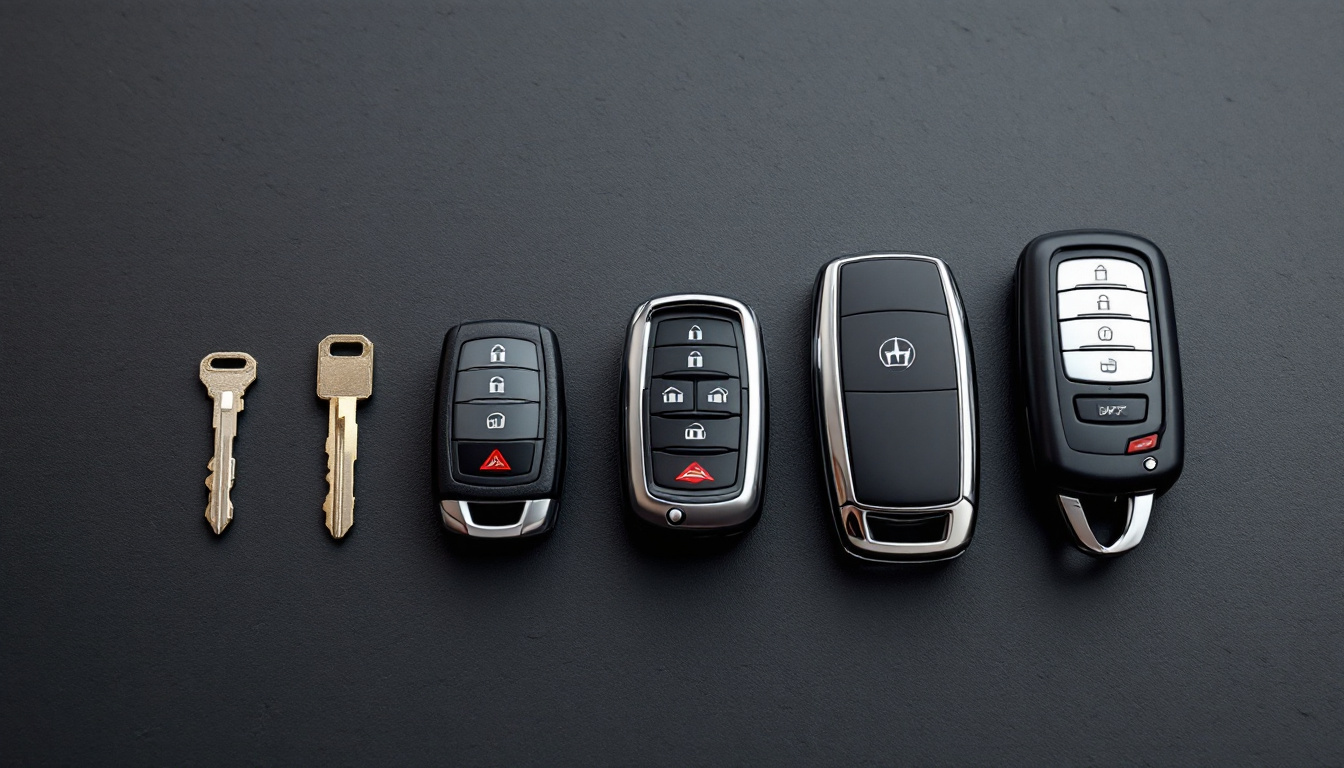
Ask what a replacement key will cost and the first question back is almost never "what brand?" — it is "what year?" That ordering is not arbitrary. Automotive key technology changed in a handful of distinct steps over three decades, and every vehicle on the road today sits in one of those eras. Which era you are in decides the hardware, the procedure, the tooling, the paperwork and the bill, far more reliably than the badge on the grille does.
As of July 2026 the fleet on American roads spans roughly thirty model years of key technology at once. This is the timeline, era by era, with what each one means when you need a key made.
The five eras at a glance
| Era | Roughly | What starts the car | Replacement job |
|---|---|---|---|
| Mechanical | Pre-1996 | A cut metal key, nothing electronic | Cut only — the cheapest key job that exists |
| Early transponder | ~1996–2004 | Cut key with a chip in the head | Cut plus chip programming |
| Remote-head key | ~2000–2012 | Cut key with buttons built into the head | Cut plus programming, pricier hardware |
| Proximity and push-button | ~2007–present | A fob in your pocket, a button on the dash | Fob plus programming, highest hardware cost |
| Digital and connected | ~2020–present | Fob, card, or a phone credential | Platform-dependent, sometimes account-linked |
The ranges overlap on purpose. Manufacturers moved at their own pace and often ran two architectures in the same showroom year, which is the single most common source of wrong-part mistakes.
Era 1 — mechanical keys, before about 1996
A key was a shaped piece of brass. The lock read the shape; nothing read the driver. Duplicating one required a blank and thirty seconds on a machine, and originating one from scratch required only the code or the ability to read the lock.
If your vehicle is genuinely from this era, you have the cheapest key situation available in the entire market. There is no programming step, no security code, no diagnostic tool, no subscription. The realistic complications are different ones: the correct blank may no longer be manufactured, and thirty-year-old lock cylinders are frequently worn to the point where a freshly cut correct key still will not turn smoothly. That is a hardware problem, not a key problem — and it is exactly the failure pattern described in our guide to telling the key from the ignition.
The wider issue with this era is obsolescence. When the blank is discontinued and the dealer's parts system returns nothing, you are in the territory covered by what to do when the dealer says they cannot make that key anymore.
Era 2 — the transponder arrives, roughly 1996 to 2004
This is the hinge point of the whole story. A passive radio-frequency chip went into the key head; a coil around the ignition cylinder energized it and read back an identifier; the engine control unit refused to keep running without a recognized answer.
The change was driven by theft. Immobilizers made hot-wiring obsolete as a practical technique, and the effect on theft rates for equipped vehicles is well documented by safety and insurance researchers [2], alongside the federal theft-prevention framework that pushed the industry in that direction [1].
For key replacement, three things changed permanently:
- Cutting metal stopped being sufficient. Every key now needs an electronic enrollment step.
- A diagnostic tool with current vehicle coverage became mandatory equipment.
- Ownership verification became part of the job, because the key now authorizes starting rather than merely fitting.
Early-era transponder systems are, ironically, among the friendlier jobs today: the protocols are mature, tool coverage is excellent, and the hardware is inexpensive. The mechanics of that enrollment step are covered in transponder and smart key programming explained, and the current cost picture in transponder key programming cost.
Era 3 — remote-head keys, roughly 2000 to 2012
The remote fob and the key merged into one object: a cut blade, a chip, and lock/unlock buttons in a single head. Convenient, and quietly expensive, because now a cracked plastic housing or a failed button meant replacing an item that also carried the immobilizer chip.
The practical lesson from this era is that key failure became a much broader category than key loss. Buttons wear out. Housings crack at the blade joint. Batteries die. None of those are lost keys, and none require a new key to be originated — points our key fob replacement guide works through in order of what to rule out first.
This era also established the FCC identifier as a practical shopping tool. Every remote transmitter sold in the United States carries an equipment authorization ID that is publicly searchable [3], and matching that ID is far more reliable than matching photographs when you are looking at replacement parts.
Era 4 — proximity fobs and push-button start, roughly 2007 onward
The key left your hand. The vehicle now broadcasts a challenge, the fob answers from your pocket, and the door handles and the start button behave accordingly. There is usually a hidden emergency blade inside the fob and a backup way to start the vehicle when the fob battery dies — a slot, a marked spot on the column, or a specific hold-the-fob-against-the-button procedure.
Three consequences for replacement:
Hardware cost jumped. A proximity fob is a small computer with a radio, and it is priced like one. This is the largest single reason a newer vehicle's key costs multiples of an older one's, and why published consumer estimates for replacement span such a wide band [6]. We put the difference side by side in smart key replacement cost vs transponder.
All-keys-lost got heavier. With no working fob, the technician has to establish trust from scratch, and on many platforms that runs through a credentialed manufacturer-data channel that logs who requested what and why [4]. Our walkthrough of what an all-keys-lost job involves covers that process.
A new theft vector appeared. Relay attacks, which extend the conversation between a fob sitting on a hall table and a car on the driveway, are a real and tracked phenomenon in national theft data [5]. Later vehicles in this era added motion-sensing fobs that stop transmitting when still, and ultra-wideband ranging that measures actual distance rather than mere signal strength.
Era 5 — digital, connected and account-linked, roughly 2020 onward
The newest layer is not a new key so much as a new credential system. Phone-as-key, card keys, driver profiles tied to an account, and over-the-air updates that can change how the security stack behaves after the vehicle leaves the factory.
What this means practically:
- The physical key still exists. Every vehicle sold with phone-as-key also ships a physical credential, because a dead phone cannot be allowed to strand a driver.
- Some functions now live in an owner account rather than in the car, which introduces a step that has nothing to do with locksmithing: transferring or removing credentials when a vehicle changes hands.
- Coverage from independent tooling arrives later on the newest platforms than on established ones — usually a matter of software catching up, not a permanent exclusion.
Electric vehicles concentrate several of these traits at once, which is why they get their own treatment in digital and EV car key replacement.
The trap: model year is a clue, not a fact
Everything above is a map, and a map is not the territory. Three patterns break the year-to-technology assumption regularly:
Mid-generation architecture changes. A nameplate carries across a change in the underlying security system. Two vehicles badged identically, built four months apart, can need different parts and different procedures.
Overlapping platforms in one showroom year. During a redesign, the outgoing model often stays in production alongside the new one. Two cars wearing the same model year are then two entirely different jobs.
Trim and options. Passive entry was optional equipment on many models for years. The base vehicle and the loaded vehicle from the same line are not the same key.
The defence is trivial and universal: quote from the VIN. The VIN encodes the actual build, which is why every competent shop asks for it before pricing, and why the difference shows up in our cost by make guide as ranges rather than fixed numbers.
Placing your own vehicle in sixty seconds
Skip the research and answer four questions:
- What do you physically do to start it? Turn a metal key (Era 1–3), insert a fob and twist (late Era 3 / Era 4), or press a button (Era 4–5).
- Does the key head have buttons? Yes puts you at Era 3 or later.
- Is there a security or immobilizer icon on the dash at startup? Present from Era 2 onward.
- Does the vehicle start and then die after two or three seconds? That specific symptom is an immobilizer refusing a key, which means Era 2 or later.
Those four answers plus your VIN are enough for any competent shop to identify the exact procedure and quote flat rather than in a range — the difference we explain in anatomy of a car key quote.
What to do with this
The most useful conclusion from the timeline is a boring one: the older your vehicle, the cheaper a spare key is today, and the gap widens every year as older platforms age out and newer hardware gets more expensive. Whatever era you are in, a second key made while the first still works converts a future emergency into a routine appointment.
To compare shops without repeating your vehicle details five times, get matched sends them once to screened automotive locksmiths. You can also browse the directory directly or start from a state hub such as Texas, California or Pennsylvania.
Frequently asked questions
When did cars start using transponder keys?
Chip-based immobilizer keys began appearing on premium models in the mid-1990s, spread rapidly through mainstream vehicles in the late 1990s and early 2000s, and were effectively universal on new vehicles in the United States by the mid-2000s. The exact year varies by manufacturer and even by trim, which is why the VIN rather than the model year is the deciding evidence.
How do I tell if my key has a chip in it?
Three quick indicators. A thick black plastic head on an otherwise plain metal key usually houses a chip. A key that unlocks the doors but will not keep the engine running is behaving exactly like an unprogrammed chip key. And any vehicle from roughly the 2000s onward almost certainly has one. A shop can confirm in seconds with a chip detector.
Which model years are the most expensive for key replacement?
Generally the newest ones. Proximity fobs cost more as hardware than any earlier key format, and the newest platforms sometimes add security steps that lengthen the job or restrict who can perform it. The cheapest era is the pre-chip period before the late 1990s, where a key is genuinely just cut metal.
Does a newer car always need the dealer for a key?
No, though the proportion of dealer-only work rises with model year. Well-equipped independent shops cover the great majority of vehicles on the road, including most recent ones. Dealer-only situations cluster around the very newest platforms, a handful of manufacturers with restrictive security policies, and cases where a security module itself has to be replaced.
What is phone-as-key and does it replace a physical key?
Phone-as-key uses a smartphone with a secure digital credential in place of a fob, over Bluetooth or ultra-wideband. It is a convenience layer rather than a replacement: vehicles equipped with it still ship physical keys or cards, still have a backup way to start, and still need conventional key service when the physical credential is lost.
Why do two cars of the same model year need different keys?
Because manufacturers change architecture mid-generation, run outgoing and incoming platforms side by side during a redesign, and vary hardware by trim. Passive entry, a fob slot, or a plain remote-head key can all be options rather than model attributes. The VIN encodes the build; the model year alone does not.
Sources cited
- NHTSA — Vehicle theft prevention and the federal theft-prevention standard (2024).
- Insurance Institute for Highway Safety — Vehicle theft and anti-theft technology (2024).
- Federal Communications Commission — Equipment authorization and FCC ID lookup (2024).
- National Automotive Service Task Force — Secure Data Release System & Vehicle Security Professional registry (2024).
- National Insurance Crime Bureau — Vehicle theft trends and prevention resources (2024).
- AAA — Car key replacement cost guidance (2024).