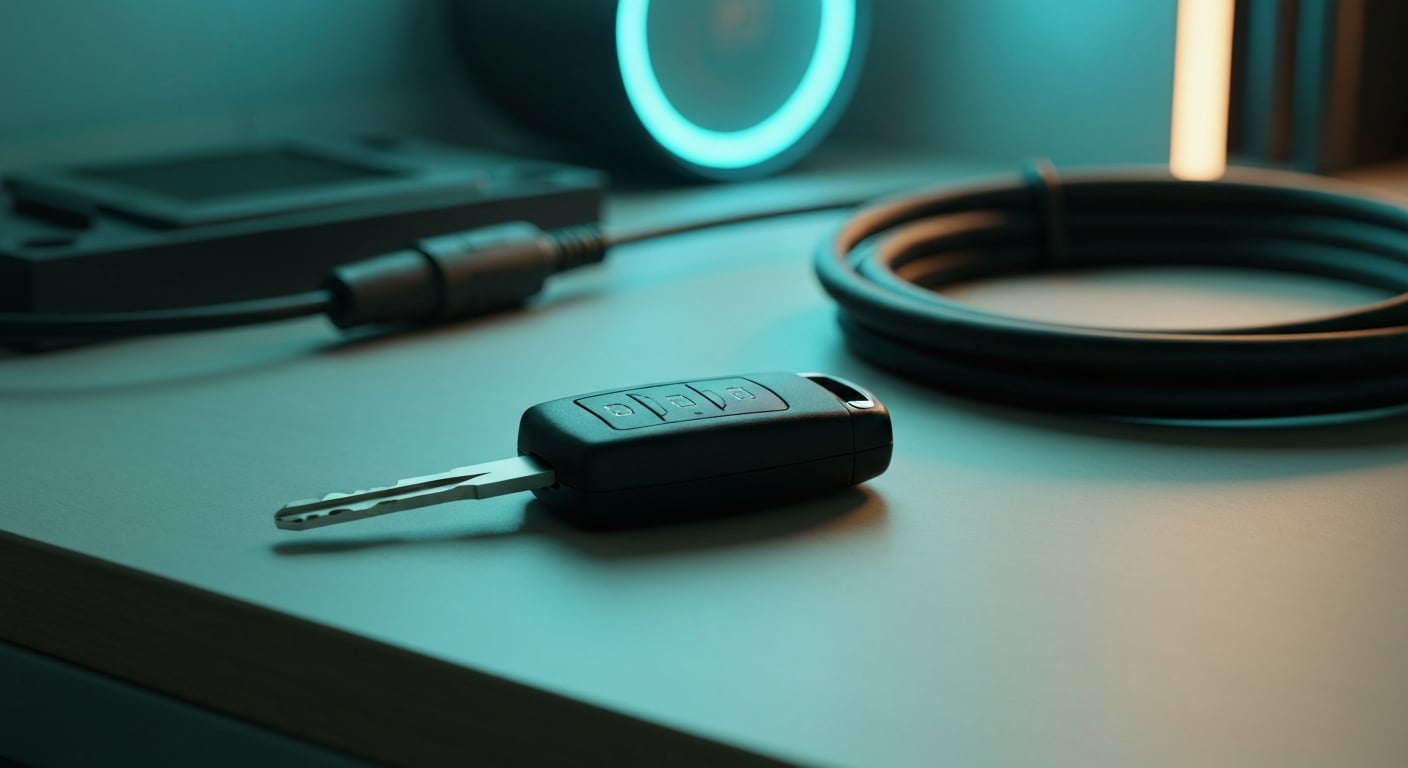
Short answer, as of July 2026: a cut-and-programmed transponder key from an independent automotive locksmith typically falls in the high tens to low-to-mid hundreds of dollars, with programming-only work — where you already have the correct key — at the lower end, and all-keys-lost jobs above the range entirely. Published consumer guidance on car-key replacement supports that span [1]. Dealer pricing for the same work is generally higher once a tow and a scheduled appointment are included.
That is the number. The rest of this guide explains what you are paying for, because "programming" is the invisible half of the job and therefore the half people most suspect of being padding. It is not padding, and the reason is worth understanding before you compare quotes. For the underlying technology, our companion guide on transponder and smart-key programming covers how the chip and the immobilizer actually talk to each other.
What "programming" is buying
A transponder key contains a small chip with no battery. When the key is near the ignition, the vehicle's antenna energizes it, the chip answers with a coded identifier, and the immobilizer decides whether to allow the engine to run. Engine immobilizers became effectively universal in the wake of federal theft-prevention policy [2], and their effect on theft rates for equipped vehicles is well documented [3].
Programming is the act of getting the immobilizer to add your new chip to its list of trusted identifiers. That is a security operation, not a data-entry step, and manufacturers deliberately make it non-trivial. What varies — and what drives your price — is how non-trivial it is on your particular vehicle.
Three methods, three price points
| Method | What happens | Typical vehicles | Relative cost |
|---|---|---|---|
| On-board / manual sequence | A documented sequence performed at the vehicle, sometimes needing two working keys | Older mainstream vehicles | Lowest |
| Diagnostic (OBD) programming | Professional tooling connects to the diagnostic port and enrolls the key, often with a security code | Most vehicles from the mid-2000s on | Middle |
| Authenticated / module-level | An authenticated online session with the manufacturer, or reading the security module directly | Late-model and premium platforms, most all-keys-lost cases | Highest |
The first method costs the least because it needs almost no equipment. The second reflects the cost of professional diagnostic tooling and its subscriptions — a real and recurring business expense that a shop amortizes across jobs. The third adds credentialed access: technicians obtaining manufacturer security data in the U.S. commonly do so through the Secure Data Release System, which requires current Vehicle Security Professional credentials and documentation of both the business and the vehicle owner's authorization [4].
Nothing about your vehicle's badge tells you which row applies. Its model year and immobilizer generation do.
The five things that move your number
- Whether you have a working key. The single biggest multiplier. Adding a key is routine; starting from zero is a different job class — we cover it in all keys lost.
- Key hardware. A bare transponder blank is a small fraction of a remote-head key, and a fraction of a fraction of a proximity fob.
- Programming method. The table above.
- Number of keys in one visit. The second key programmed during the same session is dramatically cheaper than a separate later call, because the setup cost is already sunk.
- Where you are. Locksmiths are tracked as a distinct skilled occupation with wage variation across states and metros [5], and regional price levels differ measurably across the country [6]. The same job is genuinely priced differently in different markets.
Item 4 is the one within your control today. If you are already paying for a technician's time and the module is already open, the marginal cost of a spare is the cheapest key you will ever buy.
Why the technician appears to be doing nothing
A recurring source of suspicion: the technician plugs in a tool, then sits for a stretch of time doing apparently nothing, then the key works. This is usually a mandatory security delay built into the immobilizer's key-learning routine — an intentional design choice that makes brute-force attempts impractically slow.
No tool shortens it. It is not the shop padding the clock. If you want to sanity-check, ask before work starts whether your platform has a security wait and how long it is; a technician who knows the platform will answer immediately.
Why the labor line is not just labor
A recurring objection: "it took him twenty minutes, why is the labor more than the key?" The honest answer is that you are not buying twenty minutes of a person's time — you are buying access to a capability that costs a shop money every month whether or not you call.
A working automotive locksmith carries, at minimum:
- Professional diagnostic tooling, which is a substantial capital purchase and typically carries an annual subscription for the vehicle-coverage updates that keep it working on new model years.
- Key-cutting equipment, including machines capable of the high-security laser-cut profiles most modern vehicles use.
- Inventory, because the reason a mobile locksmith beats the dealer on speed is that the part is already in the van. Stocking blanks and fobs across dozens of platforms is working capital sitting on a shelf.
- Credentialed access, where applicable, with its own registration and per-event costs [4].
- Vehicle, fuel and insurance, since the service comes to you.
Spread across the jobs a shop actually books, that overhead is most of what the labor line represents. It is also precisely why the cheapest advertised number in a search result is so often not real: an operation with none of that overhead cannot do the work, which is why the price changes on arrival.
The second-key arithmetic
The single highest-return decision in this entire article is what you say when the technician asks whether you want two.
Programming a second key during the same visit reuses everything expensive: the identification, the ownership check, the security access, the tool setup, and the mandatory delay if your platform has one. All of it is already paid for. The incremental cost is the hardware plus a short enrollment step.
Compare that with the alternative. Decline the spare, lose your single key in eighteen months, and the next call is an all-keys-lost job — the most expensive scenario in this trade, at the top of the published range [1], plus a wait, plus possibly a tow. The spare you declined would have converted that entire event into a routine add-a-key visit at the bottom of the range.
Framed as insurance, it is unusually good insurance: a one-time premium, no deductible, no claim process, and it pays out precisely in the scenario that costs the most.
Comparing quotes without being misled
Two quotes are only comparable if they cover the same scope. Ask every shop the same five questions:
- Is this price all-in — blank or fob, cutting, and programming?
- Is there a separate service-call or travel fee, and is it charged if I decline?
- What does a second key cost in the same visit?
- Is there an after-hours or weekend surcharge?
- Will you put the total in writing before you dispatch?
That last one is the Federal Trade Commission's core recommendation for this trade: get the total price and the business's credentials in writing before work begins, and treat an on-arrival increase as a reason to stop [7]. A "programming only, $XX" advertisement that excludes the key is the most common way a quote looks cheaper than it is.
Our seven-point verification check covers the rest of the vetting; dealer vs locksmith covers when the franchised dealer is genuinely the right answer rather than the default one.
Retail kiosks, online kits and the DIY question
Three DIY-adjacent options come up constantly:
Retail key kiosks. Some can duplicate certain transponder keys when a working key is present, on a defined vehicle list. Useful for a spare on an older mainstream car; no help at all for all-keys-lost, proximity fobs, or platforms requiring a security code.
Online fob plus a cheap programmer. The tooling sold to consumers generally covers on-board procedures only — the cheapest row of the table, on vehicles that were already the cheapest to key. If your car needed the middle or bottom row, the kit will not do it, and previously-paired fobs frequently refuse to enroll.
Buying the part, hiring the labor. Legitimate and sometimes cheaper, but confirm first that the shop accepts customer-supplied parts and what happens if the part will not program. Many decline; many that accept exclude the part from any warranty.
Getting a real number for your vehicle
The published range at the top of this page is a sanity check, not a quote. To convert it into a firm figure, give a shop the year, make, model and VIN, and state clearly whether you have a working key. That is enough for a competent automotive locksmith to identify your exact immobilizer generation and quote flat.
If you would rather not repeat that five times, get matched sends the vehicle details once to screened automotive locksmiths so you can compare firm prices before dispatch. You can also browse the directory by state and city — for example California, Illinois or Arizona — or read our broader car key replacement cost breakdown for context on other key types.
Frequently asked questions
How much does transponder key programming cost in 2026?
Published consumer guidance places a cut-and-programmed transponder key broadly in the high tens to low-to-mid hundreds of dollars as of July 2026, with programming-only work at the lower end of that span and all-keys-lost jobs above it. The exact figure depends on your vehicle's immobilizer generation, the key hardware, and local labor rates — which is why a VIN-based quote beats any published range.
Is programming charged separately from cutting?
It varies by shop. Many quote a single all-in price covering the blank, the cutting and the programming; others itemize. Ask which model you are being quoted, because a low "programming" figure that excludes the key itself is not comparable to an all-in number.
Can a hardware store program a transponder key?
Some retail key kiosks can duplicate certain transponder keys when a working key is present, on a limited list of vehicles. They generally cannot help with all-keys-lost, proximity fobs, or platforms requiring a security code — which is most of the modern market.
Why does the technician sit and wait during programming?
Several immobilizer systems impose a mandatory security delay during a key-learning procedure. It is an intentional anti-attack measure and no tool shortens it. On those vehicles the wait is a fixed part of the job time.
Is programming cheaper if I bring my own key?
Sometimes, but many shops decline customer-supplied parts or exclude them from any warranty, because an uncertified or previously-paired unit may refuse to enroll. Confirm the policy before buying anything.
Does programming a new key erase my old ones?
Adding a key alongside a working one usually leaves existing keys intact. All-keys-lost procedures frequently wipe the entire stored key list, which is the security-correct result when a key is genuinely missing. Ask which is happening on your vehicle.
Sources cited
- AAA — Car key replacement cost guidance (2024).
- NHTSA — Vehicle theft prevention and the federal theft-prevention standard (2024).
- Insurance Institute for Highway Safety — Vehicle theft and anti-theft technology (2024).
- National Automotive Service Task Force — Secure Data Release System & Vehicle Security Professional registry (2024).
- U.S. Bureau of Labor Statistics — Occupational Employment and Wages: Locksmiths and Safe Repairers (49-3071) (2024).
- U.S. Bureau of Economic Analysis — Regional Price Parities by State and Metro Area (2023).
- Federal Trade Commission — Hiring a Locksmith (2023).