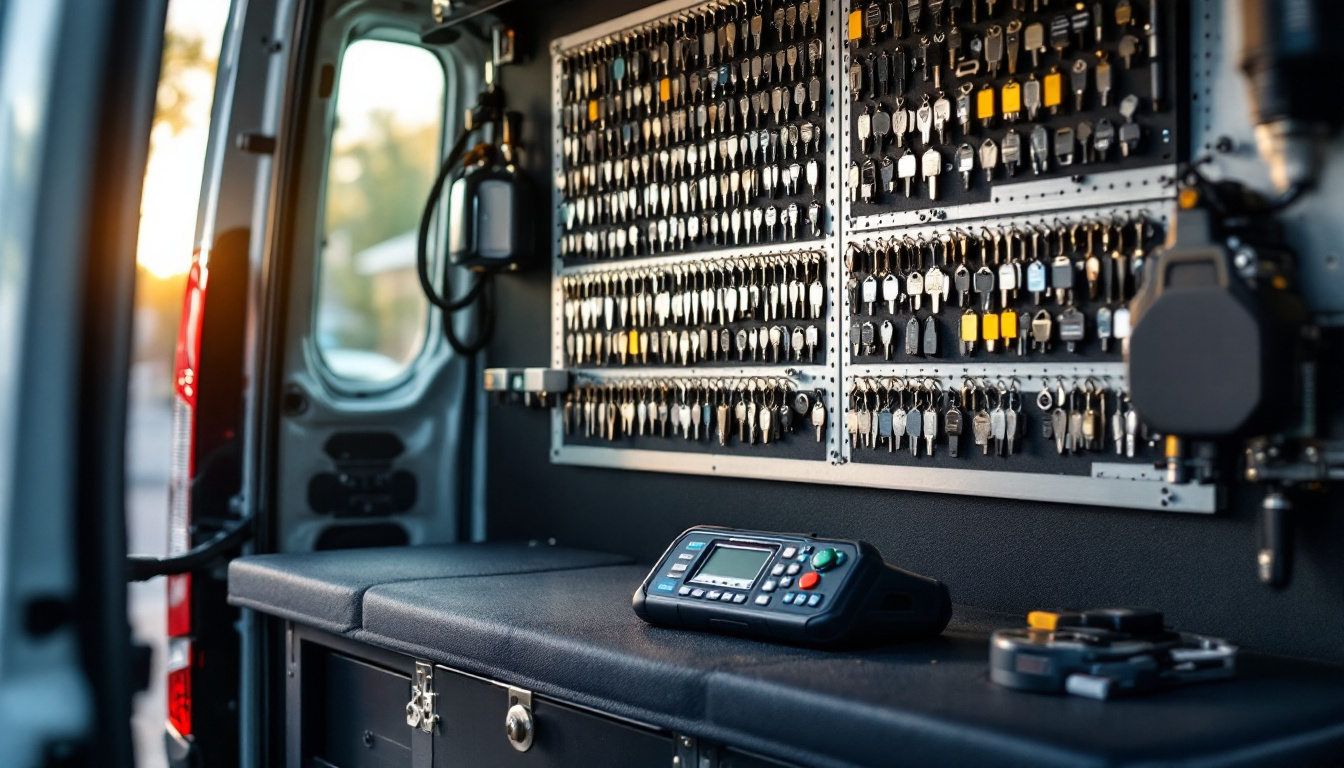
"Automotive locksmith" is one of those job titles everyone half-recognizes and almost nobody can define. People picture someone who pops open a locked door with a wire coat hanger, which describes maybe one afternoon of the work and none of the equipment. The modern version of this trade is closer to a mobile electronics specialist who happens to also cut metal.
That gap matters, because it is the reason so many calls end in mutual frustration. A driver phones about a no-start and gets told it is not a key problem. A shop is asked to program a fob for a car the caller is still negotiating to buy. Somebody wants a key for a boat. As of September 2026, here is the honest scope of the trade, nationally — what an automotive locksmith does, what they sometimes do, and what is firmly somebody else's job.
The core: four categories of work
Nearly everything a car-key shop does falls into four buckets.
1. Key origination and duplication. Cutting a mechanical key — either copied from an existing one or originated from the vehicle's key code when there is no key left to copy. Origination is the harder half and the one that separates an automotive specialist from a hardware-store key machine. It requires the correct blank for that vehicle's keyway, a machine capable of the cut style, and a legitimate route to the code.
2. Electronic key programming. Enrolling a transponder chip, a remote-head key, or a proximity fob into the vehicle's immobilizer so the engine will actually run. Since engine immobilizers became effectively universal equipment on new vehicles — the security architecture that federal theft-prevention policy encouraged and that measurably reduced theft of equipped cars [3] — cutting metal on its own stopped being enough. We cover the mechanics of that step in transponder and smart key programming explained.
3. Lockouts and physical entry. Opening a locked vehicle without damaging the door, the glass or the weather seal. High volume, quick, and completely separate as a skill from key work.
4. Lock and ignition hardware service. Rebuilding or replacing door cylinders, trunk locks, glovebox locks and ignition lock cylinders — the mechanical parts that wear out after a decade of a key being twisted in them.
Everything else the trade does is a variation or a combination of those four.
The scope table
| Job | Automotive locksmith | Typical alternative |
|---|---|---|
| Spare key cut and programmed | Yes — core work | Dealer, at higher cost |
| All keys lost, key made from scratch | Yes — core work | Dealer, usually with a tow |
| Fob remote not working | Yes — diagnose and replace | Dealer |
| Vehicle locked, keys inside | Yes — most shops | Roadside assistance |
| Key snapped in the ignition | Yes — extraction and replacement | Dealer or mechanic |
| Key will not turn in ignition | Usually — if the cylinder is the fault | Mechanic if electrical |
| Ignition switch electrical failure | Sometimes — often referred out | Mechanic |
| Immobilizer or security module replacement | Sometimes — depends on tooling | Dealer |
| Engine cranks but will not run, no security light | No | Mechanic |
| Steering column mechanical damage | Rarely | Body shop or mechanic |
| Making a key for a vehicle you cannot document | Never | Nobody legitimate |
The table is deliberately blunt about the middle rows. That grey band — ignition faults that could be mechanical or electrical — is where most misdirected calls land, and it is worth ten seconds of triage on the phone before anyone drives anywhere. If your symptoms sit in that zone, our diagnostic walkthrough on whether the problem is the key or the ignition is the faster read.
Why "locksmith" alone is not enough information
Ask a general locksmith directory for help with a car and you will often be routed to a business that has never opened a vehicle. The two trades share a name and a professional lineage and almost nothing else in daily practice.
A building locksmith's day involves pin tumblers, master-keying charts, door closers, exit devices, and safes. Their van carries a pinning kit and a stock of cylinders. An automotive locksmith's van carries key blanks in dozens of keyways, a code-cutting machine, several diagnostic programmers with active software subscriptions, and a laptop. The federal occupational classification lumps them together [4], but the equipment cost alone tells you they are separate businesses in practice: an automotive programming toolkit with current vehicle coverage is a recurring five-figure commitment, renewed annually, that a residential shop has no reason to carry.
This is precisely why a directory that separates the two exists. When you browse listings by state here, the automotive filter is the point — a general locksmith listing is not a car-key answer.
The parts of the job people do not expect
Three elements of the work routinely surprise first-time callers.
Documentation is mandatory, not bureaucratic theater. Before originating a key, a legitimate shop verifies that you have a right to the vehicle. On many modern platforms, access to the manufacturer security data required to complete the job runs through a credentialed channel that logs the technician's identity and the reason for the request [2]. This is the single most common point of friction on a first call, and the reason we wrote a full proof-of-ownership checklist.
The key is often a smaller cost than the labor and the tooling. Consumer guidance broadly places modern replacement in the low-to-mid hundreds of dollars, with all-keys-lost work at the top of the range [6] — and much of that reflects mobile labor and the amortized cost of programming equipment rather than the plastic in your hand. Our breakdown of the anatomy of a car key quote unpacks the line items.
Radio compliance is a real constraint on parts. Every remote sold in the United States carries an equipment authorization identifier, publicly searchable through the FCC [5]. Shops use it to confirm compatibility, and it is the reason a fob that looks identical to yours in a photograph may still be the wrong part.
The six jobs that are not a locksmith's
To save you a phone call:
- General mechanical repair. A no-start with no security warning, a dead battery, a fuel or starter problem — mechanic. The dividing line is easiest to see in a specific symptom: a car that starts and then shuts off a second later belongs to whichever trade the spare-key test points at.
- Electrical faults outside the security chain. Body-control gremlins, wiring damage, parasitic drains.
- Airbag, ABS and emissions work. Different certifications entirely.
- Title and registration problems. A shop cannot make a key for a vehicle whose ownership you cannot document, and it is not their role to resolve why you cannot.
- Repossession and disputed-possession work. Legitimate shops decline these outright.
- "Just this once, no ID." Not a service anyone should offer, and a shop that offers it has told you exactly how it would treat a stranger standing next to your car.
The fourth and sixth points are the ones worth internalizing. The paperwork friction is the mechanism that stands between a stranger and your vehicle.
Within the four categories that are this trade’s work, what you pay turns mostly on which key your vehicle uses — the tiers are set out in car key replacement cost by key type.
Mobile, shop-based, or both
Automotive locksmiths operate in three shapes, and it changes what you should expect.
Fully mobile. A van and a service radius. This is the dominant model for car-key work because the vehicle is usually where the problem is, and a stranded car cannot be driven to a counter. The trade-off is drive time, which is the single biggest variable in how long the whole thing takes — see how long a car key replacement really takes.
Shop-based. A physical location you drive to. Often cheaper per job because there is no travel, and better equipped for stubborn work like a seized cylinder that needs bench time. Useless when the car will not move.
Hybrid. Both, priced differently. Most established businesses land here.
Coverage density varies enormously across the country, which is a real constraint rather than a marketing detail; we mapped what that looks like nationally in automotive locksmith coverage across the U.S. You can also start from a state hub — California, New York, Texas or Florida — to see how many listed shops sit near you.
Licensing is a state matter, not a national one
There is no single federal license for this trade. Requirements range from a state-issued security or locksmith license with fingerprinting and a background check, through business-registration-only regimes, to states with no specific requirement at all. That variation is large enough that "licensed" means genuinely different things depending on where you are standing, which is why we maintain a state-by-state breakdown in automotive locksmith licensing by state.
Whatever your state requires, the federal consumer guidance is the same everywhere: confirm the business's identity and get the total price in writing before work begins [1]. Our seven-point verification check turns that into a script you can run on the phone in ninety seconds.
How to describe your problem so you reach the right trade
The fastest route to a correct answer is to describe symptoms rather than diagnose. Say what happens, in this order:
- What you do to start the vehicle: turn a metal key, insert a fob and twist, or press a button.
- What the vehicle does: nothing at all, cranks but will not run, or starts and dies within seconds.
- What the dashboard shows: a security or immobilizer icon, a key symbol, or nothing unusual.
- Whether you have any working key at all.
- Year, make, model, and the VIN.
Those five facts sort the call into the right trade almost every time. A start-and-die with a security light is a key or immobilizer problem. A silent no-start with no security light is usually not. And a vehicle that starts perfectly with one key but not the other has told you the fault is in the key.
If you would rather send the details once and let several shops respond, get matched forwards them to screened automotive locksmiths instead of you repeating the story five times.
Frequently asked questions
Is an automotive locksmith the same as a regular locksmith?
No. Residential and commercial locksmiths work on building hardware — deadbolts, mortise locks, master-key systems, safes. An automotive locksmith works on vehicles, which means key origination, transponder and smart-key programming, ignition cylinders and immobilizer electronics. Some shops do both, but the tooling, training and parts inventories barely overlap, and a strong building locksmith may not touch cars at all.
Can an automotive locksmith make a key with no original key?
Yes, on most vehicles. That is the defining capability of the trade and it is called all-keys-lost work. The technician originates a mechanical key from the vehicle key code or by reading the lock, then enrolls a new transponder or fob into the immobilizer using diagnostic equipment, after verifying that you own the vehicle.
Do automotive locksmiths do lockouts?
Most do, and for many shops it is the highest-volume call. Opening a locked vehicle without damage is a distinct skill from key work, and it is worth knowing that a lockout and a lost-key job are priced very differently — a lockout is a door-opening; a lost key is a manufacturing and programming job.
Can an automotive locksmith fix my ignition switch?
Frequently, yes, when the fault is in the mechanical lock cylinder — a worn wafer set, a key that will not turn, a cylinder that spins freely. When the fault is electrical, in the switch behind the cylinder or in a control module, the job crosses into automotive repair and many locksmiths will hand it to a mechanic. Ask which of the two your shop handles before dispatch.
Will an automotive locksmith work on a motorcycle, RV or boat?
It varies widely by shop, and none of it should be assumed. Motorcycles and powersports vehicles use their own key and immobilizer systems; RVs may have one system for the chassis and another for the coach; marine ignition is different again. Ask about your specific vehicle type when you call rather than assuming a car shop covers it.
What can an automotive locksmith not do?
They do not perform general mechanical repair, they do not resolve electrical faults outside the lock and immobilizer chain, they do not settle title or ownership disputes, and no legitimate shop will make a key for a vehicle you cannot show a right to. Anything sitting outside the key, the lock, and the security modules that authorize starting is usually a mechanic, a dealer, or a lawyer.
Sources cited
- Federal Trade Commission — Hiring a Locksmith (2023).
- National Automotive Service Task Force — Secure Data Release System & Vehicle Security Professional registry (2024).
- NHTSA — Vehicle theft prevention and the federal theft-prevention standard (2024).
- U.S. Bureau of Labor Statistics — Occupational Outlook Handbook, locksmiths and safe repairers (2024).
- Federal Communications Commission — Equipment authorization and FCC ID lookup (2024).
- AAA — Car key replacement cost guidance (2024).