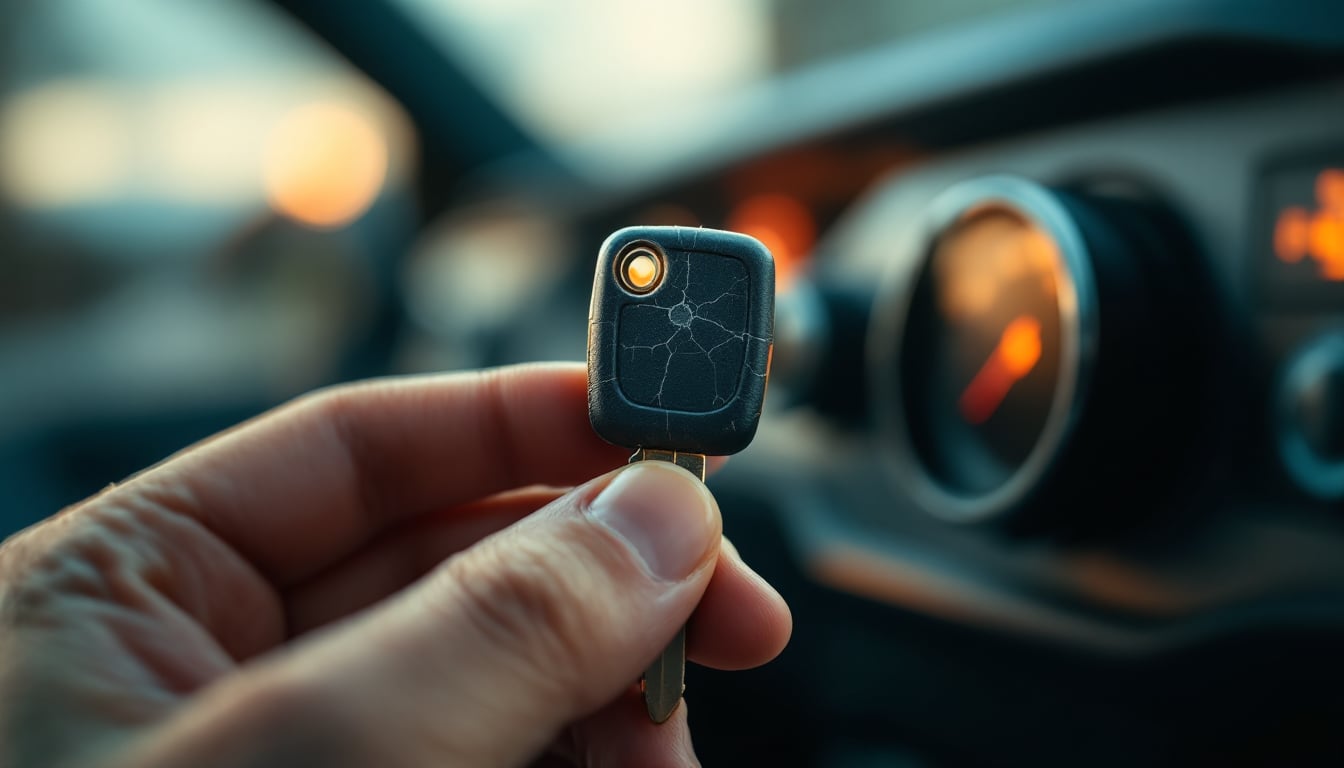
It fails on the first try, works on the second, and behaves perfectly for a fortnight afterwards. Nobody books a repair for that. The car is drivable, the problem is inconsistent, and there is always something more pressing.
That is the trap. Intermittent is not a category of fault sitting between "fine" and "broken" — it is the sound a component makes on its way to failing completely. Every mechanism that produces intermittent behaviour in a key system gets worse with use and none of them recovers. What you are watching is a countdown, and the useful thing about a countdown is that you can act during it.
Acting during it is also dramatically cheaper, because a key made while another key still works is a routine job, while a key made after the last one dies is the most expensive version of this work.
What intermittent means physically
Modern keys sit in a chain, and each link has a way of going marginal instead of dead.
An immobilizer transponder is a passive chip with no battery of its own. An antenna coil around the ignition lock energises it and reads its reply. Immobilizers became effectively universal under the federal theft-prevention framework [1], so this chain exists in nearly every vehicle on the road — the handshake itself is described in transponder and smart key programming explained.
Three of those links fail gradually rather than suddenly. A hairline crack in a solder joint or in the chip's coil opens and closes with temperature and vibration. A wire in the steering column, flexed every time the column is adjusted, breaks strand by strand and keeps conducting on the remaining ones. A worn lock cylinder lets the key sit slightly out of position, moving the chip a few millimetres away from the coil that has to reach it.
All three produce the same user experience: it works, until it does not, until it does again. None of them heals.
Reading the pattern
The circumstances of the failures are the diagnosis. Most people have already collected this data without writing it down.
| When it fails | What that points at | Fixable side |
|---|---|---|
| Works after wiggling the key or holding it at an angle | Physical break in the key head, or a worn cylinder | Key or ignition |
| Fails cold in the morning, fine later | Cracked joint or coil that closes as it warms | Key |
| Fails with a heavy key ring, fine when the key is alone | Side load pulling the key out of position in a worn lock | Ignition cylinder |
| One key misbehaves, the other never does | The failing key itself | Key |
| Both keys behave identically | The vehicle — antenna ring, wiring or module | Vehicle |
| Push-to-start car fails at a distance, works held against the button | Fob battery near end of life, or weak transmitter | Key |
| Getting steadily more frequent over weeks | Any of the above, now late in its life | Whichever side above |
Two patterns deserve a closer look than the rest. If one key misbehaves and another never does, the asymmetry is proof the vehicle is healthy — the reasoning is laid out in one key works and the other does not. If both keys act the same way, suspicion moves to the car, which is the situation examined in both keys stopped working at once.
Four things to establish this week
Try the spare deliberately, for a full day. Not once — a day. Intermittent faults hide from single tests. If the spare gets through a normal day of driving with no misbehaviour, you have narrowed the fault to the first key and saved yourself a vehicle-side diagnosis.
Watch what the dash does at the moment of failure. A security or key-shaped symbol flashing during a failed attempt tells you the immobilizer is refusing, which is different from a no-crank or a stumble. If the failure ends with the engine catching and dying a second later, the more specific guide is the car starts, then shuts off a second later.
Strip the key ring. Two things at once here: a lighter ring removes side load on a worn cylinder, and separating other transponders removes any chance of radio interference at the ignition aerial. Both are free.
Note whether the blade itself feels different. A key that has to be jiggled, that turns roughly, or that feels loose in the cylinder is telling you about mechanical wear rather than electronics, and that is a different repair with a different trade. Is it the key or the ignition separates those two properly.
Keep the notes. A shop given "fails cold, fine after ten minutes, only this key" will reach the answer far faster than one given "sometimes it doesn't start", and a shorter visit is a cheaper visit.
Repair, reprogram or replace
Three outcomes, and they cost very different amounts.
Rebuild the shell. If the electronics are sound and the housing is cracked, worn or has a floppy flip blade, many keys can be rebuilt into a new shell with the original circuit and blade transferred across. It is the cheapest real fix in this subject, and you generally have to ask for it by name.
Reprogram. Occasionally the key is physically fine and the vehicle's registration of it has degraded or been lost, commonly after a deep battery discharge or a control module replacement. That is tool time with no parts line at all.
Replace. A failing transponder chip or a broken internal coil is not sensibly repairable. What that costs depends mostly on which type of key your vehicle uses, which is broken down in car key replacement cost by key type; published guidance puts a chipped key replacement in the low-to-mid hundreds of dollars once hardware and programming are counted [2]. If yours is a proximity fob rather than a bladed key, the key fob replacement cost guide is the closer fit.
If the fault turns out to be vehicle-side — an antenna ring, a loom, a module — you are into ordinary repair territory, and independent guidance on choosing a repair shop is worth reading first [3]. Be aware that a replaced immobilizer or engine control module often has to be programmed to the vehicle afterwards, which on many platforms requires credentialed access to manufacturer security data through the Secure Data Release System [4], as described in all keys lost and secure data release explained.
The deadline nobody mentions
Here is the arithmetic that makes this worth doing today rather than eventually.
While one key still starts the car on some attempt, an additional key is a routine job: the vehicle can be woken, its security system opened through the working key, and the new key enrolled in a normal session. That is the ordinary tier of this work.
Once no key works at all, the same physical key becomes a substantially larger job — extended time on site, ownership verification, and on many vehicles a manufacturer security-data request before enrolment can even begin. That is the tier described in what replacement costs with no spare, and it typically lands well above the routine case on the identical vehicle.
The difference between those two prices is decided by when you call, not by what is wrong. And an intermittent key does not send a final warning before it stops — it simply fails one more time and does not recover. If the deadline arrives at night or on a weekend, an after-hours dispatch premium lands on top of it, as set out in emergency car key replacement after hours.
The same logic is why a car with only one key at all is worth fixing before anything is even wrong with it: the argument is made in full in spare key cost and when to get one and, for anyone who has just bought a vehicle, in used car with one key: what to do.
Booking it sensibly
Call while the car still starts, which means you can choose a weekday appointment rather than an emergency dispatch. Give the shop your year, make and model, the VIN, the failure pattern you wrote down, and whether a second key exists and behaves.
Ask three questions. Can the shell be rebuilt, or does the key need replacing outright? Will the second key be programmed at the same visit, and what does that add? And is the quoted total the price on the driveway, including the trip? The Federal Trade Commission's guidance on hiring a locksmith covers the rest of the vetting — confirm the business identity, get the price before work starts, and treat a number that changes on arrival as the warning it is [5], with a practical checklist in how to verify an automotive locksmith.
It is also worth asking how long the visit will take, because an intermittent fault sometimes needs diagnosis before replacement; the realistic ranges are in how long a locksmith takes to make a car key. To find shops covering your vehicle, browse automotive locksmiths by state and city and give two of them the same pattern notes.
Frequently asked questions
Why does my car key work sometimes but not others?
Almost always because something in the chain is marginal rather than broken — a cracked solder joint or coil inside the key head, a transponder chip that has weakened, a partly broken antenna wire in the steering column, or a fob battery near the end of its life. A marginal connection makes contact on some attempts and not others, which is why jiggling the key or trying again appears to work. It is early failure, and it progresses in one direction.
Does the pattern tell you which part is failing?
It narrows it usefully. A key that works after being wiggled or held at an angle points at a physical break in the key or the cylinder. A key that fails when cold and works when warm points at a cracked joint that closes as it expands. A key that fails only when the ring is heavy points at side load on the ignition lock. And if a second key never misbehaves, the failing key is the fault rather than the vehicle.
Is an intermittent key dangerous to keep using?
It is not a safety hazard while driving, because immobilizers only prevent starting rather than stopping a running engine. The risk is being stranded. An intermittent rejection becomes a permanent one without warning, and if it happens when you are away from home with no spare, you have moved from a routine replacement into the most expensive version of this job.
Can a weak key fob battery cause intermittent starting?
On a push-to-start vehicle, yes — a dying cell produces exactly this behaviour, working close to the receiver and failing at a distance or in cold weather. On a traditional chipped ignition key it usually cannot, because the transponder chip is passive and takes its power from the antenna coil rather than from the battery. That distinction is why a battery swap fixes some intermittent cars instantly and does nothing for others.
Should I replace the key or repair it?
A cracked or worn shell with sound electronics can often be rebuilt into a new housing, transferring the original blade and circuit, which is far cheaper than a new programmed key. A failing transponder chip or a broken internal coil cannot be repaired sensibly and needs a replacement key. Ask specifically which case you are in, because a shop that only sells complete units may not volunteer the rebuild.
How do I know whether the key or the ignition is at fault?
Compare behaviour across keys and across functions. If one key misbehaves and another never does, the failing key is the fault. If both keys act the same way, look at the vehicle — the antenna ring around the ignition lock is the usual suspect. If the blade also feels loose, sticky or needs jiggling to turn, you are probably dealing with mechanical wear in the cylinder rather than an electronic fault.
What should I do first if I only have one key and it is intermittent?
Get a second key made while the first one still works on some attempts. Programming an additional key with a working key present is a routine job; doing it after the last key dies puts you in the all-keys-lost tier, which costs considerably more and takes longer. The intermittent phase is a warning with a window attached, and the window is the cheap part.
Sources cited
- NHTSA — Vehicle theft prevention and the federal theft-prevention standard (2024).
- AAA — Car key replacement cost guidance (2024).
- Consumer Reports — Car maintenance and repair guidance (2024).
- National Automotive Service Task Force — Secure Data Release System & Vehicle Security Professional registry (2024).
- Federal Trade Commission — Hiring a Locksmith (2023).