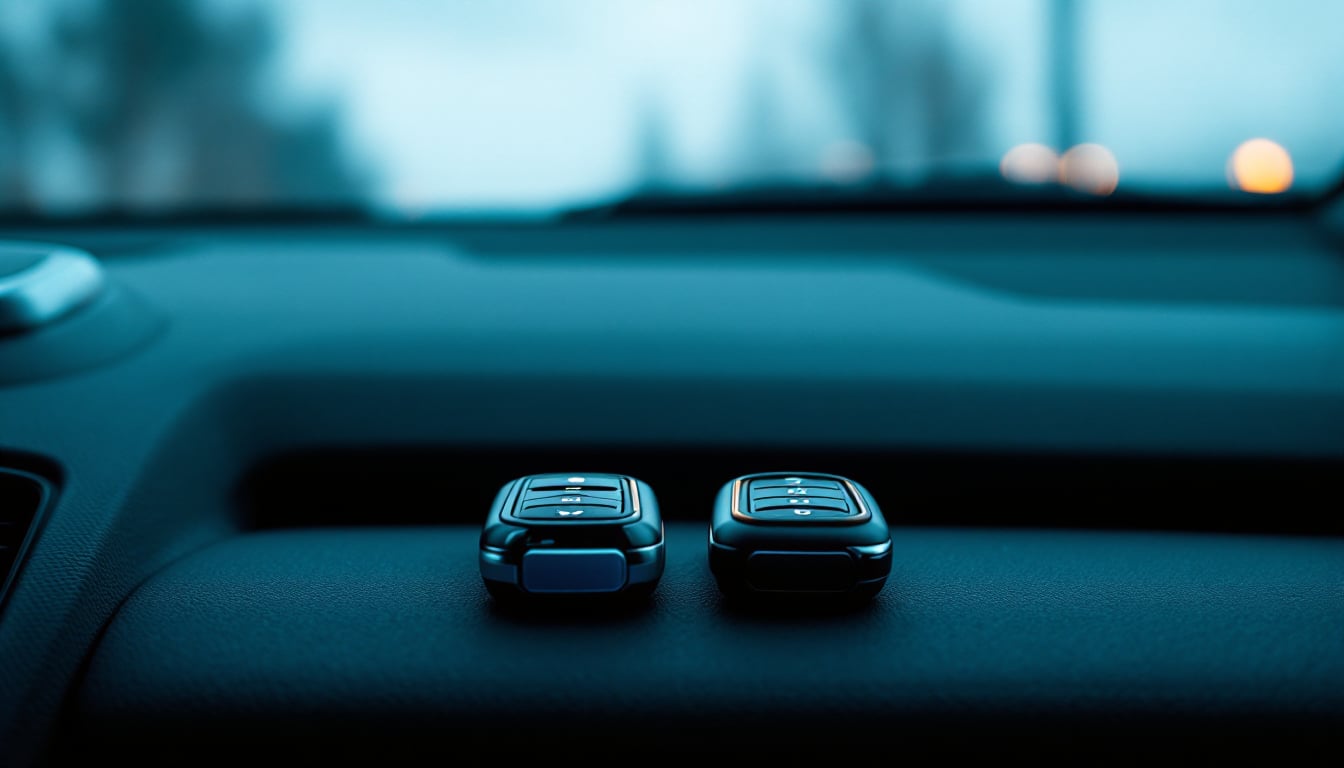
Yesterday both keys worked. This morning neither does — the buttons do nothing, the doors stay locked, and on a push-button car the dashboard insists there is no key present.
That sounds twice as bad as one key failing. It is usually the opposite. As of August 2026, the fact that every key failed at the same moment is a strong and specific clue, pointing somewhere far narrower than a shopping trip for new fobs.
The inversion at the heart of this
There is a companion diagnosis that says almost the reverse. When one key fails while the spare still works, that asymmetry largely exonerates the vehicle — the spare has just proved the battery, the receiver, the antennas and the security module all function, so the fault lives inside the key that failed. That reasoning is worked through in one key works and the other does not.
Now run it backwards. If every key failed at the same moment, the keys are the one thing they do not have in common — separate devices, with separate coin cells, separate boards and separate histories of being dropped and rained on. What they share is the car: its battery, its fuses, its receiver, its antennas and its security module. Two independent pieces of electronics do not usually die on the same night by chance.
So the first move is not to buy a fob. It is to find which part of the vehicle stopped listening — and most candidates are cheaper than a key.
What else you observe
The keys behaving identically is one data point. The rest of the car is the other.
| What else you observe | Most likely cause | Who fixes it | Relative cost |
|---|---|---|---|
| Dash lights dim, slow crank, or a rapid clicking | Weak or dead 12V battery | Parts counter, or a mechanic | Lowest |
| Everything else electrical is normal, no key detected | Blown fuse feeding the receiver or body-control module | Parts counter, then a mechanic | Lowest |
| Doors lock and unlock from the interior button, fobs do nothing | Failed receiver or antenna module | Auto-electrical shop or dealer | Moderate to high |
| Security or immobilizer telltale flashing, engine will not start | Body-control or immobilizer fault | Locksmith or dealer | Moderate to high |
| Failed the day after a module replacement or a keys-made visit | Wiped or corrupted key table | Automotive locksmith | Low to moderate |
| Failed after a leak, a flood, or a persistently wet footwell | Water in a vehicle-side module | Auto-electrical shop | Moderate to high |
| Started right after an alarm, remote-start or accessory install | Aftermarket wiring near the receiver | The installer | Low to moderate |
| Both coin cells were bought and fitted on the same day | Genuine coincidence — two flat cells | Owner | Trivial |
| The mechanical blade will not open the driver's door either | Lock cylinder, unrelated to the electronics | Automotive locksmith | Low |
The causes, cheapest and most common first
1. A weak or dead 12V battery. By a wide margin the most common answer, and the most under-suspected: drivers expect a failing battery to announce itself by refusing to crank, and it misbehaves long before that. Keyless entry and passive-entry systems sit at the low-current end of the electrical system and are among the first things to go erratic as voltage sags — intermittent detection, then none. A battery that starts the car on a warm afternoon can leave the receiver deaf on a cold morning. Batteries are a scheduled ownership cost rather than a surprise [6], and testing one is free at most parts counters.
2. A blown fuse. There is rarely a fuse labelled for the fob, but almost always one feeding the keyless-entry receiver, the body-control module, or the circuit they depend on. When it goes, the symptom is precisely this: every key ignored at once while the rest of the car looks healthy. The owner manual gives the fuse box locations and the layout diagram, and the part costs almost nothing. A fuse that blows again immediately is reporting a short downstream — a matter for a shop, not a second fuse.
3. A failed receiver or antenna module. The vehicle needs something to hear the fob's radio burst and, on passive-entry cars, antennas to sense the key near the doors and inside the cabin. When the receiver or its wiring fails, every key goes silent at once — the textbook profile. The giveaway is that everything else works normally — interior lights, door-lock buttons, dash, ignition.
4. A body-control or immobilizer fault. One layer deeper sits the module that decides whether the engine may run. Immobilizers became effectively universal after the federal theft-prevention framework pushed the industry that way [1], with a documented effect on theft rates [2]. That benefit carries a diagnostic cost: when the module misbehaves, valid keys are refused and the car reports it in the vaguest possible language. The tell is the security telltale — flashing, or lit and staying lit — rather than anything the fobs do.
5. A wiped or corrupted key table. The mirror of a cause in the companion piece, seen from the vehicle's side. A replaced body-control or security module can arrive holding an empty or mismatched list of authorised keys, and a previous all-keys-lost visit clears that table by design, enrolling only the keys present on the day. Either way the keys are undamaged and the vehicle no longer recognises them. Credentialed access to those procedures runs through an established framework [3], explained in all keys lost and secure data release. If a module was replaced or keys were made recently, say so on the phone — it collapses the diagnosis immediately.
6. Water in a vehicle-side module. Blocked sunroof or cowl drains, a failed windscreen seal or a leaking heater core can put water exactly where the body-control module or receiver lives — on many vehicles low in the cabin or under a seat. The pattern is a wet carpet nobody connected to the electrical symptoms, plus several unrelated systems misbehaving at once.
7. Aftermarket electronics near the receiver. An alarm, a remote-start system, a stereo, a dashcam or a hard-wired accessory fitted close to the receiver or spliced into its circuit can interfere with it or disturb its supply. The diagnostic value is entirely in the timing: if both keys stopped within days of an installation, that installation is the first suspect and the installer the first call.
8. The genuine coincidence. Two coin cells bought in the same pack and fitted on the same afternoon have discharged in parallel ever since, so they can reach the end of their lives within days of each other. This is the one cause that really is about the keys, and it is worth ruling out early because it is cheap. If one fob was used daily and the other lived in a drawer, be sceptical — that pair should not expire together.
Five tests before anyone is paid
Does the mechanical blade open the driver's door? Most fobs hide an emergency blade, and most vehicles keep a driver's-door cylinder even where the handle conceals it. If it opens the door, the mechanical side is intact and you have the cabin access every other test needs. If it binds, there is a separate lock problem as well.
Does the engine crank normally? The fastest voltage check available without a meter. A slow, laboured crank or a rapid clicking sends you straight to cause one. A confident crank does not clear the battery entirely — marginal voltage can still upset a receiver — but it moves it down the list.
What do the interior lights, dash and door locks do? Work the lock button on the door panel. If the locks cycle normally, the actuators and body wiring are fine and the failure is specifically in the part that listens for a key. Dim or flickering interior lighting, or several unrelated warnings at once, points back at power or a body-control module.
What does the security telltale do? Note whether the key or padlock icon is off, flashing, or lit and staying lit, and whether it changes when you try to start. That one observation separates a car that cannot hear a key from one that hears it and refuses it — the difference between a receiver fault and an immobilizer fault, and between two trades.
Does the passive backup position work? Nearly every push-button vehicle has a documented way to start with a fob the car cannot otherwise detect: a slot, a marked spot on the column, or holding the fob against the start button, all of which read the key at a couple of centimetres. If the car starts that way, it can still authorise your key and the failure is in reception — the antennas, the receiver, or their power. That is a genuinely useful finding, and free. If it will not start that way either, authorization is implicated and the list narrows toward the security module and the key table.
Two of those five cost nothing and take a minute, and none require a new fob — which is the point.
Who fixes what, and roughly what it costs
The parts counter. A battery test and a fuse are the bottom of the cost ladder — consumable-level, and between them they account for a large share of simultaneous key failures. Start here even when it feels too simple.
An auto-electrical shop or general mechanic. Charging-system faults, wiring, water-damaged modules and receiver diagnosis are their work. Expect diagnostic time to be charged before a part is named — finding the fault is the job. Costs run from modest for a battery and terminals to substantially more where a module and its programming are involved.
An automotive locksmith. Keys, transponders, key-table enrolment and lock cylinders. If the fault is a wiped or mismatched key list, this is who re-enrols the keys you already own, usually without new hardware — the cheapest vehicle-side outcome. If keys genuinely must be replaced, published guidance places that broadly in the low-to-mid hundreds of dollars, with the most demanding platforms higher [5], and the technology on your model year drives where inside that span you land, as car key technology by model year sets out.
The dealer. A minority of late-model security-module faults route back to a franchised dealer, which normally means a tow as well as the repair. It is the most expensive path, and correct only once the cheaper explanations are genuinely eliminated.
Whichever it is, expect an identity and ownership check before anyone programs anything to the car — the discipline that makes the system trustworthy, covered in proof of ownership for car key replacement.
What to tell them when you call
Lead with observations, not a theory. Five get a correct answer over the phone almost every time: that every key failed, and when; whether the engine cranks; what the interior lights and door-lock buttons do; what the security telltale shows; and whether anything happened just beforehand — a flat battery, a jump start, a module replacement, an accessory installation, a leak. Add year, make, model and VIN.
That is enough for a competent shop to name the likely fault and the right trade before dispatch. Then apply the ordinary consumer caution: establish who the business actually is and get the total price before work begins [4]. If a shop's first move is to quote a pair of new fobs without asking about the vehicle, that is worth a second opinion. If the real symptom turns out to be an engine that starts and dies, or a key that will not turn, is it the key or the ignition sorts those patterns instead — and when a single fob quits rather than all of them, what to check first when a fob stops working is the short version.
To describe the vehicle once rather than repeat it to several shops, get matched passes the details to screened automotive locksmiths for firm quotes before dispatch.
Frequently asked questions
Both of my car keys stopped working at the same time. What does that mean?
Almost always that the fault is in the vehicle rather than the keys. Two fobs are separate devices with separate batteries, separate boards and separate histories of being dropped, so they rarely fail together by chance. What they share is the car — its battery, its fuses, its receiver and its security module — and that shared hardware is where to look first.
Can a weak car battery stop a key fob from working?
Yes, and it is the single most common explanation. Keyless entry and passive-entry systems are among the first things to misbehave as system voltage falls, often well before the engine refuses to crank. A battery that starts the car fine on a warm afternoon can leave the receiver unreliable on a cold morning, so voltage is worth ruling out before anything is bought.
Is there a fuse for the key fob?
Not usually a fuse labelled for the fob, but almost always one feeding the keyless-entry receiver, the body-control module or the interior electronics it depends on. The owner manual identifies the fuse box locations and the layout diagram. It is inexpensive to check, and a blown fuse produces exactly this symptom — every key ignored at once, with the rest of the car apparently fine.
Both fobs stopped right after a module was replaced. Is that a coincidence?
Very unlikely. Replacing a body-control or security module can leave the vehicle holding an empty or mismatched list of authorised keys, so perfectly healthy keys are refused. The keys do not need replacing in that case — they need re-enrolling to the module that is now fitted. Tell whoever you call about the recent work, because it changes the diagnosis immediately.
Do I need a new key fob if neither one works?
Rarely, and it belongs near the end of the list rather than the start. A new fob only helps if the keys themselves are the fault, the least likely reading of a simultaneous failure. The one exception worth taking seriously is the coincidence case — if both coin cells were bought and fitted on the same day, they can genuinely expire together.
How do I get into and start the car in the meantime?
Most fobs hide a mechanical blade, and most vehicles keep a lock cylinder in the driver's door even where the handle conceals it, so that combination usually gets you inside. For starting, nearly every push-button vehicle has a documented backup position — a slot, a marked spot on the column, or holding the fob against the start button — that reads the key at very short range. Both are in the owner manual.
Sources cited
- NHTSA — Vehicle theft prevention and the federal theft-prevention standard (2024).
- Insurance Institute for Highway Safety — Vehicle theft and anti-theft technology (2024).
- National Automotive Service Task Force — Secure Data Release System & Vehicle Security Professional registry (2024).
- Federal Trade Commission — Hiring a Locksmith (2023).
- AAA — Car key replacement cost guidance (2024).
- Consumer Reports — Car maintenance and ownership-cost guidance (2024).