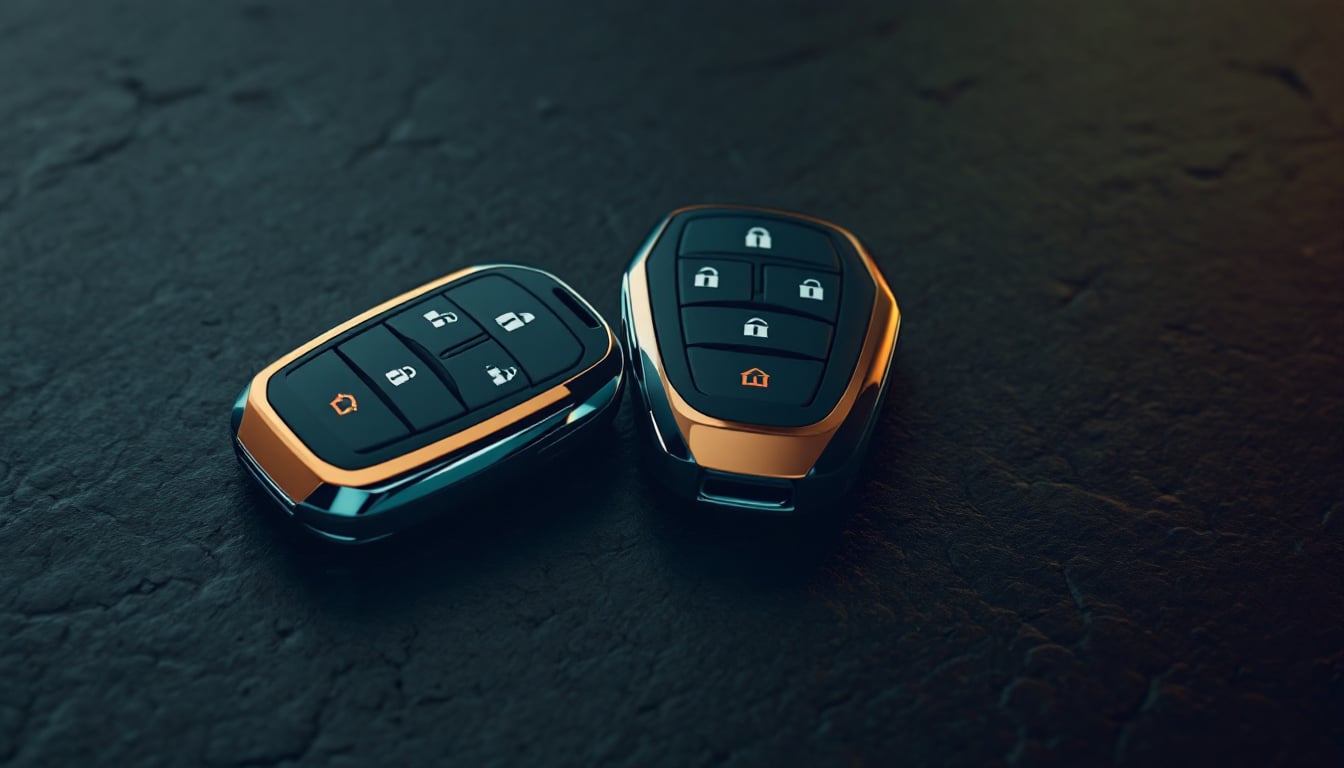
Two keys came with the car. This morning one of them did nothing — no lock, no unlock, no start. The other one, retrieved from a kitchen drawer, worked on the first press.
That is not a coincidence to be annoyed about — it is the most useful diagnostic information in the whole situation, and it arrived free. As of October 2026, an asymmetry between two keys on one vehicle narrows the field faster than any test a shop can run, because it eliminates almost everything expensive before anyone opens a toolbox.
What the asymmetry actually proves
When the spare works normally in the same place at the same moment, a long list of components has just demonstrated that it is healthy: the vehicle battery, the wiring, the receiver module, the antenna ring that reads the chip at the ignition, the passive-entry antennas in the doors, and the security module that authorises the engine. None of those can be the fault, because the spare just used them all.
Those are the costly failures. A failed receiver module or a damaged antenna ring is vehicle work at vehicle prices. A failed key is a key, and published guidance places replacement broadly in the low-to-mid hundreds of dollars at the upper end [6] — with several outcomes below landing far under that.
The mirror image matters too. If every key misbehaves identically, the vehicle is the suspect and a new key will not help — both car keys stopped working at once runs this reasoning the other way. Where the car starts and dies, or a key will not turn, is it the key or the ignition separates those patterns instead.
The symptom table
Read the failing key against the spare, then find the row.
| Symptom pattern (failing key, spare working) | What it points at | Likely fix | Relative cost |
|---|---|---|---|
| Buttons do nothing at any distance | Flat coin cell, or a broken battery contact | New cell, then contact cleaning | Lowest |
| Buttons work only when the fob is squeezed | Fatigued contact spring or cracked solder joint | Contacts, or replace the fob | Lowest to moderate |
| Buttons lock and unlock, engine will not start | Transponder chip or its antenna coil | Re-enrol, or a new key | Moderate |
| Blade will not turn the ignition, or turns the door only | Worn or slightly bent blade | Fresh cut from the vehicle key code | Low |
| Push-button car detects it only against the start button | Weak cell, or weak transmit from a damaged board | New cell first, then a new fob | Lowest to moderate |
| Stopped working right after a flat battery or module job | Lost pairing | Re-pair the existing key | Low to moderate |
| Key was elsewhere during a past all-keys-lost job | Erased from the vehicle key table | Re-enrol the existing key | Low to moderate |
| Fob survived water or a laundry cycle, now weak or dead | Corrosion on the board | Replace the fob | Moderate |
| Aftermarket fob that never worked reliably | Previously paired or uncertified unit | Replace with a known-good part | Moderate |
The causes, ranked cheapest and most common first
1. A flat coin cell. The overwhelmingly common answer, and the reason to try it before buying anything. The two keys were never used equally — the daily key transmits many times a day, the drawer key barely at all — so they age at completely different rates. Spent cells belong in household battery recycling rather than the bin [4].
2. Corroded or fatigued battery contacts. A cell that measures fine at rest is useless if its spring has lost tension or the pad has oxidised. The signature is intermittency — it works when squeezed, or after a tap. Cleaning them resolves a surprising share of what looks like a dead key.
3. A worn button pad. The conductive material behind each rubber button wears through with use, so one button dies while the others carry on. The fault is a few cents of carbon.
4. A worn or bent metal blade. Every insertion abrades the blade slightly, and after enough years the peaks and valleys no longer lift the lock wafers to their correct heights. The key that did all the work fails while the drawer key — cut identically, barely used — still turns. The fix is a fresh cut from the vehicle key code, not a copy of the worn key, which would reproduce the wear. If neither key turns the ignition, the wafers have worn, and that is cylinder work.
5. A cracked transponder chip or de-bonded antenna coil. Inside the head sits a small chip and a coil that powers it by induction from the vehicle's antenna. Years of drops onto concrete can crack the chip or break the coil's bond. The result is the informative split described below — the buttons still transmit, the engine still refuses.
6. Water ingress. Rarely instant death. A fob that went through a wash cycle often works at first, then degrades over weeks as corrosion spreads across the board.
7. Lost pairing after an electrical event. On some platforms a flat vehicle battery, an awkward jump start, or a replaced body or security module can disturb the stored relationship between key and car. Nothing is broken; the vehicle has stopped recognising a credential it used to accept. The tell is timing.
8. Erased during a previous all-keys-lost job. This deserves far more attention than it gets. When a technician programs keys for a vehicle with none, the secure procedure typically wipes the existing key table and enrols only the keys present that day. A key that was at home, at a relative's, or with a former owner was in that table and now is not. It is undamaged and re-enrols quickly, but nothing warns the owner — it simply stops working with no event to attribute it to. Credentialed access to those procedures runs through an established framework [3], described in all keys lost and secure data release. If the vehicle has ever had keys made, this is live.
9. Counterfeit or previously paired aftermarket units. A fob that never really worked is a different story from one that worked for years. Uncertified electronics, and units already married to another vehicle, can refuse to hold a pairing or drop out weeks later. It is a common finding on a used car with mismatched keys — one reason buying a used car with only one key is worth handling deliberately rather than trusting whatever turns up in the glovebox.
Four tests to run before calling anyone
The swap test, in both directions. Everyone tries the spare; far fewer run it the other way. Take both keys to the same spot and try each on every function — unlock at ten paces, at arm's length, trunk, panic, start — then repeat somewhere else. That second location separates a key fault from an environment problem: a key that fails in one place and works in another is telling you about the place.
The backup or passive start position. Nearly every push-button vehicle has a documented way to start with a fob whose radio is dead — a slot in the console, a marked spot on the column, or a hold-it-against-the-start-button routine that reads the chip at very short range. It is in the owner manual. If the failing key starts the car this way, the transponder is alive and the fault is the battery or the transmitter — the cheap half.
The mechanical blade in the driver's door. Most fobs hide an emergency blade, and most vehicles keep a driver's-door cylinder even when the handle covers it. If the blade turns it cleanly, the cut is within tolerance. If it binds or will not enter, you have a mechanical fault with nothing to do with electronics.
The lock-but-not-start split. If the failing key still locks and unlocks but will not start the engine, note it — the most diagnostic observation in this article. Buttons and transponder are separate systems sharing one housing: the buttons are an active radio transmitter powered by the coin cell, the transponder a passive chip energised by the vehicle's antenna at a few centimetres. Working buttons prove the battery is good and the board still transmits, so the fault is on the transponder side — a damaged chip, a broken coil, or an erased enrolment. Immobilizers became effectively universal after the federal theft-prevention framework pushed the industry that way [1], with a documented effect on theft rates [2].
What each outcome realistically costs
The bands below are relative; the figure depends on platform, key type and where you are.
Trivial. A coin cell, cleaned contacts, a replacement button pad, or a new housing shell taking the existing board and blade. A shop that jumps past all of them to a new key, when the spare works fine, is worth a second opinion.
Low. A fresh blade cut from the vehicle key code for a healthy key — quick, and it spares the cylinder further wear.
Low to moderate. Re-enrolling a physically sound key — no new hardware, only a programming session. This is where an erased key or a lost pairing lands: the hardware in your hand is fine.
Moderate. A new key or fob, cut and programmed. The price is driven by key technology and platform rather than by the symptom, and this is the band published replacement-cost guidance describes [6]. A spare bought now is markedly cheaper than an emergency one later — the arithmetic in what a spare car key costs.
Reprogram, re-cut, or replace
Three jobs hide behind "my key stopped working", and the tests above choose between them.
Reprogram when the hardware is intact and only the enrolment is gone — the erased key, the post-electrical-event key, and the used-car key that was never enrolled to this vehicle at all. No new hardware is involved, only a programming session and the time it takes.
Re-cut when the electronics respond but the blade does not turn — cutting to code, not duplicating the worn key.
Replace when the board itself has failed — cracked solder, broken antenna trace, corrosion. Board-level repair on a modern fob is rarely offered and rarely warrantied, so a replacement unit with a warranty is usually the better purchase. The exception is a fob that has simply been wet: opening it, removing the battery and cleaning the board is worth trying before anything is bought, and the steps are in key fob got wet: what to do. Options are covered in the key fob replacement guide, and the shortest sequence for a completely dead fob is in what to check first when a fob stops working.
Bring both keys
Arrive with every key the vehicle has, including the failed one.
A working key present changes the procedure: adding a key beside a functioning one is shorter than convincing a vehicle that can see no valid credential, and shorter jobs are cheaper. The failing key lets the technician confirm the fault rather than infer it. And on many platforms the enrolment step writes a complete list — every key that should keep working has to be present, or the one left behind becomes the next to mysteriously stop working.
If the session ends with neither key recognised, the asymmetry this guide relies on has gone and the fault has moved to the vehicle. That is a different estimate, described in immobilizer repair cost.
Then apply the caution any consumer transaction deserves: confirm who the business is and get the full price before work begins [5]. To describe the vehicle once rather than to five shops, get matched passes the details to screened automotive locksmiths for firm quotes before anyone is dispatched.
Frequently asked questions
One of my two car keys stopped working. Does that mean the car is fine?
Mostly, yes — and that is the value of the asymmetry. If the spare performs every function normally in the same place at the same time, the vehicle battery, the antenna ring, the receiver and the security module have all just demonstrated that they work. The fault is contained inside the key that failed, which is the cheapest place for a fault to live.
My key unlocks the doors but will not start the engine. What does that split mean?
That split is unusually informative. The remote buttons and the transponder are two separate systems that happen to share a housing — the buttons transmit a radio signal from the battery, while the transponder is a passive chip read at close range by an antenna around the ignition or start button. If the buttons work, the battery and radio side are alive, which points the finger squarely at the transponder circuit or at the key having been dropped from the vehicle memory.
Can a shop erase a key without telling me?
Not maliciously, but it happens routinely as a side effect. When a technician programs keys for a vehicle that has none, the standard secure procedure clears the existing key table and enrols only the keys physically present that day. Any key sitting in a drawer at home was in that table and is no longer. It is not damaged and it is usually re-enrolled quickly, but nothing about it will announce what happened.
My key stopped working right after the car battery died. Is that related?
It can be. A flat or disconnected vehicle battery, a jump start that went badly, or a control module that was replaced can all disturb the stored pairing between a key and the vehicle on some platforms. The tell is timing — if the key was fine the day before the electrical event and dead the day after, mention the event when you call, because it changes what the shop looks at first.
The blade turns the door lock but not the ignition. Is the key or the cylinder worn?
Test it against the spare in both locks. If the spare turns the ignition and the failing key does not, the blade is worn or slightly bent and a fresh cut from the vehicle key code fixes it. If neither key turns the ignition while both work the door, the cylinder is the worn part, and that is a hardware repair rather than a key purchase.
Is a failed fob worth repairing, or should it be replaced?
Batteries, battery contacts, worn button pads and cracked housings are genuinely repairable and worth doing. Cracked circuit boards, broken antenna traces and water damage generally are not — board-level repair on a modern fob is rarely offered, rarely warrantied, and often costs more in labour than a replacement unit that arrives with a warranty.
Why do shops ask me to bring both keys?
Because having a working key present changes the procedure and usually the price. Adding a key alongside a functioning one is a shorter job than establishing trust with a vehicle that cannot see any valid key at all. Bringing the failing key too lets the technician confirm the fault rather than assume it, and on many platforms all keys that should keep working must be present when the memory is written.
Sources cited
- NHTSA — Vehicle theft prevention and the federal theft-prevention standard (2024).
- Insurance Institute for Highway Safety — Vehicle theft and anti-theft technology (2024).
- National Automotive Service Task Force — Secure Data Release System & Vehicle Security Professional registry (2024).
- U.S. Environmental Protection Agency — Used household batteries and disposal guidance (2024).
- Federal Trade Commission — Hiring a Locksmith (2023).
- AAA — Car key replacement cost guidance (2024).