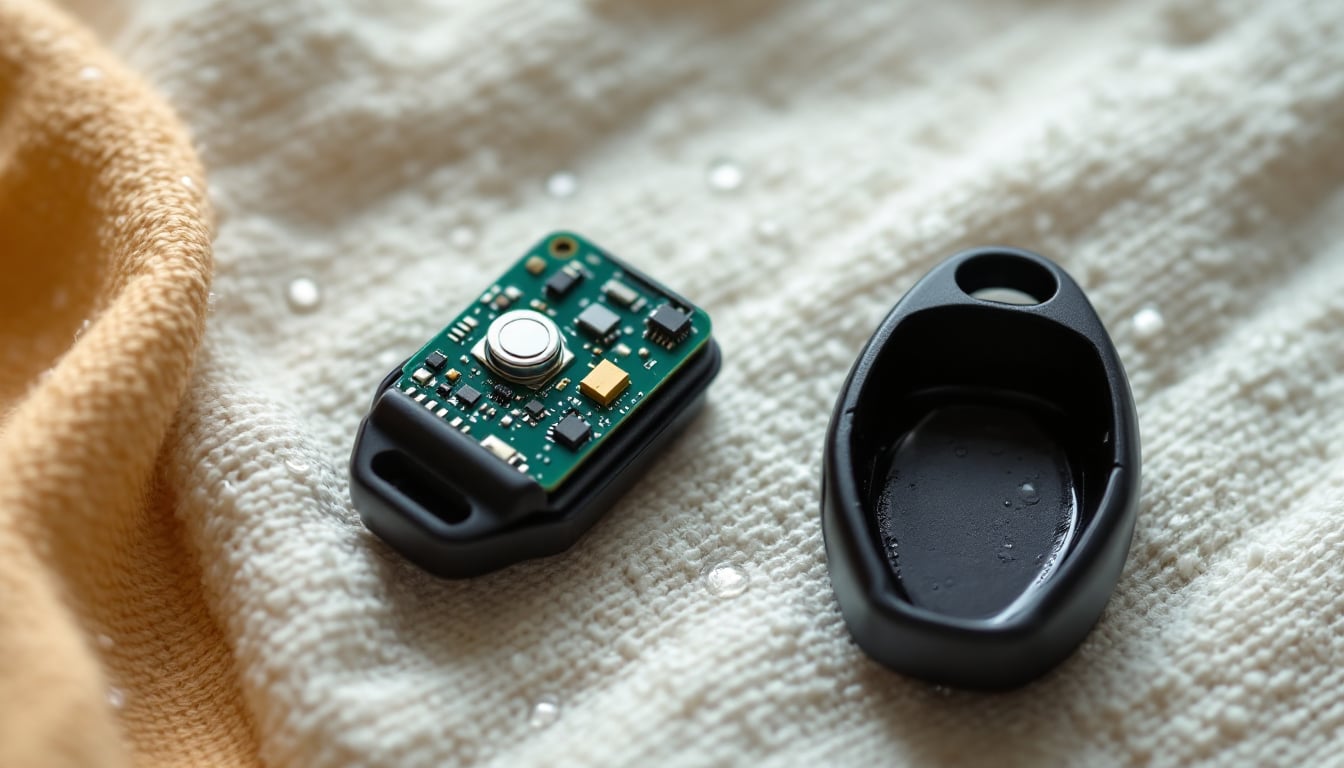
The short answer. A wet key fob is usually recoverable if the battery comes out quickly. Stop pressing buttons, open the case, remove the coin cell, dry the board and wait a full day. In the best case the repair is a new battery costing a few dollars. As of October 2026, if the fob is finished, replacement sits in the normal national bands: low-to-mid hundreds of dollars for a chipped remote key and more for a proximity fob [1].
KeyAtlas is an independent directory of third-party automotive locksmith businesses. It repairs no fobs and programs no keys. This guide explains what happens inside a wet fob and what the trade can and cannot do about it, so that you know whether you are buying a battery or a replacement.
Why the first ten minutes matter
Water on its own does not destroy electronics. A circuit board with no power on it can be soaked, dried and returned to service, and often is. The damage in a wet fob comes from the combination of water and electricity.
A key fob is never switched off. The coin cell is connected to the board all the time, holding the circuit ready for a button press. When water bridges the tracks on a powered board, two things happen. Current flows where it should not, which can damage components directly. And the metal begins to corrode through an electrical reaction that proceeds far faster than ordinary rusting. That reaction continues for as long as the board is both wet and powered.
This is why pressing the buttons to see whether the fob still works is the worst first move. Each press sends current through a wet circuit. It is also why the single most useful thing an owner can do is take the battery out, and why a fob that sat in a wet pocket for six hours with its battery in is in worse shape than one that spent a minute at the bottom of a pool and was opened on the poolside.
What to do, in order
- Stop pressing buttons. Resist the test.
- Open the case. Most remote keys split along a seam with a coin or a small flat blade in a notch. Many proximity fobs open after the emergency key blade is slid out, which reveals the slot. If the shell does not want to open, do not force it; see the note on sealed fobs below.
- Remove the battery. Note which way up it sat. Set it aside for recycling rather than reuse; a cell that has been shorted through water is not worth trusting, and button cells should go to a battery recycling point rather than the household bin [3].
- Blot, do not rub. Lift the board out if it comes free and press it between sheets of paper towel. Blot the rubber button pad and the inside of both shell halves.
- Rinse if the liquid was not clean water. This sounds backwards and is not. Salt, chlorine, detergent and sugar all leave residue that conducts and corrodes after the water has gone. A brief rinse of the board with distilled water, or better with isopropyl alcohol of high concentration, carries that residue away. A soft brush helps around the button contacts.
- Dry in moving air. Leave every part separated on a towel in a warm room, ideally near a fan. A full day is the minimum. Two is better after a full immersion.
- Fit a new battery and test. Use the cell type printed on the old one. Test lock and unlock first, then every other button.
Three things to avoid. Do not use a hair dryer on a hot setting or an oven; the shell and the button pad deform at temperatures a circuit board would tolerate. Do not rely on rice, which does little that open air does not and leaves dust behind. And do not close the case to keep things tidy while it dries.
Which water does the most damage
Not all soakings are equal, and the kind of liquid is the best predictor of the outcome.
| Exposure | How harmful | Why | Typical outcome if opened promptly |
|---|---|---|---|
| Rain or a brief splash | Low | Little water gets past the seam | Usually nothing more than a battery |
| Washing machine | Moderate | Full immersion, detergent residue, long duration | Often survives after rinse and dry |
| Fresh water immersion | Moderate | Depends almost entirely on time with battery in | Good odds if opened quickly |
| Swimming pool | Higher | Chlorinated water leaves conductive residue | Needs rinsing; mixed results |
| Sugary or milky drink | Higher | Sticky residue under the buttons and on contacts | Buttons often fail later without cleaning |
| Salt water | Highest | Strongly conductive and corrosive | Frequently fatal even with fast action |
The tumble dryer deserves its own mention. A fob that went through the wash and then the dryer has had heat added to moisture, and warped shells and lifted button pads are common. The electronics may still be fine. A replacement shell is an inexpensive fix when the board works but the case no longer holds together.
Reading what has failed
After drying and a new battery, the pattern of what works tells you where the damage is.
Everything works. You were quick. Keep an eye on it for a month, because corrosion that began before the battery came out can surface later as fading range or a button that needs pressing twice.
The buttons do nothing, but the car starts. This is the most common result and the most reassuring. The remote transmitter has failed and the immobilizer chip has survived. On a keyed vehicle the blade turns and the engine runs. On a push-button vehicle the backup position reads the chip. The car is usable while you arrange a repair or replacement. The backup procedure is described in key fob not working: what to check first.
Some buttons work and others do not. Residue under the rubber pad or on the small switches. This is the outcome most likely to be cured by a second, more thorough clean with alcohol.
It works at the car door but not across the car park. Range has collapsed. A weak cell is the first suspect, and a corroded antenna trace on the board the second.
It works some days and not others. Corrosion making and breaking a connection. Intermittent faults on the key side behave like the ones on the vehicle side, described in key works sometimes: intermittent no-start, and the comparison with a second key separates the two.
Nothing works and the car will not start. Rare, because the chip is hard to kill. Before concluding the fob is dead, check that the battery is the right way up and that the contacts are clean and springy.
If you have a spare, use it as the control. A spare that behaves normally proves the car is fine and the wet fob is the whole problem, which is the logic set out in one key works and the other does not.
Sealed fobs and the ones you cannot open
Some proximity fobs are welded or glued shut and are not meant to be opened beyond a battery door. On those, the owner's options are limited to removing the battery, shaking out what water will come, and leaving the fob battery-door-open in dry moving air for several days.
A sealed fob resists a splash better than a clip-together shell. It is also worse at letting water back out once it is in. If one has been fully submerged, treat a working result with suspicion for a few weeks, and do not let it be the only key you own.
What each outcome costs
The honest range here is unusually wide, from pocket change to the full price of a new key.
A battery. A few dollars. This is the entire repair more often than people expect.
A shell or button pad. Inexpensive. The working board and chip are moved into a new case. Make sure the transponder chip moves across too; on some keys it is a separate small capsule tucked into the shell rather than part of the board, and a key reassembled without it will open the doors and refuse to start the engine.
Cleaning or board repair. Some automotive locksmith businesses and electronics repairers will clean a corroded board or replace a failed switch. Where it is offered, it costs less than a new fob. It is not offered everywhere and it is not guaranteed, since corrosion under a component cannot always be reached.
A replacement fob. When the board is beyond saving, the job is the same as replacing any lost key of that type, and it is priced the same: a chipped remote key in the low-to-mid hundreds of dollars and a proximity fob toward the top of that range or above it [1]. The comparison between the two is in smart key replacement cost versus transponder, the fob-specific bands in key fob replacement cost, and the reasons a given vehicle sits where it does in car key technology by model year.
If you intend to buy a replacement fob yourself and have it programmed, match it by the FCC identifier printed on the old one rather than by appearance, since fobs that look identical can transmit differently [2]. The economics of that route are covered in programming a key fob you bought yourself.
When to call a professional
Call when a properly dried fob with a new battery does nothing; when a second clean has not restored the buttons; or when there is visible green or white residue on the board that will not come off.
Call sooner, before the fob has failed at all, if it is your only key. This is the point most owners miss. A fob that has been soaked may work for months and then stop on a cold morning. If a second key exists, that is an inconvenience. If it does not, the job becomes an all-keys-lost replacement, which costs more and takes longer for reasons explained in used car with one key: what to do. Adding a spare while the damaged fob still starts the car is the cheap version of a problem you can see coming, and spare car key cost and when to get one sets out the reasoning.
When you call, say what the liquid was, how long the battery stayed in, and what the fob does now. Those three facts let a business tell you whether to bring it in for cleaning or simply price a replacement. As with any key work, settle the price basis before anyone is dispatched [4], and expect to show that the vehicle is yours.
Where this directory fits
KeyAtlas lists independent automotive locksmith businesses across all fifty states and the District of Columbia, sourced from OpenStreetMap under the Open Database License with provenance recorded for every entry. It repairs nothing and does not rank or endorse the businesses it lists. If the fob is past saving, you can browse listed automotive locksmiths by state or use the matching service to be connected with a listed business that covers your area.
Frequently asked questions
What should I do right after a key fob gets wet?
Stop pressing the buttons, open the case and take the battery out. Those three steps matter more than anything that follows, because the damage comes from current flowing across a wet circuit board. Then blot the board dry, rinse it with distilled water or isopropyl alcohol if the liquid was salt water, pool water or a sugary drink, and leave everything open in moving air for at least a full day before fitting a new battery.
Will a key fob still work after going through the washing machine?
Often it will, provided it is opened and dried before it is used. A wash cycle is fresh water with detergent, which is far less destructive than salt water, and many fobs survive it. The usual casualty is the coin cell, which should be replaced regardless. If the fob works afterwards but fails weeks later, corrosion that started in the wash is the likely reason.
Does putting a wet key fob in rice work?
Rice does little that open air does not. It cannot draw water out from under components, and the dust is not good for a circuit board. Taking the fob apart and leaving it in a warm room with air moving across it dries it faster. Sachets of silica gel in a closed container are a better desiccant if you want to use one.
Can I still start the car if the fob is water damaged?
Usually, yes. The immobilizer chip inside most keys and fobs is passive and sealed, and it tends to survive when the remote circuit does not. A keyed vehicle will normally still start with the blade. A push-button vehicle has a backup position, commonly holding the fob against the start button or placing it in a marked slot, which reads the chip without the fob battery. The owner manual gives the location.
How much does it cost to replace a water damaged key fob?
As of October 2026, a coin cell costs a few dollars and is the whole repair in the best case. If the fob itself is finished, replacement falls in the same national bands as any other key of its type: low-to-mid hundreds of dollars for a remote-head chipped key, and more for a proximity smart fob. Cleaning or repairing the circuit board sits between those two outcomes.
Is water damage to a key fob covered by warranty or insurance?
A vehicle warranty covers defects, and liquid damage is normally treated as accidental rather than a defect. Some key replacement plans sold with vehicles or through insurers do cover accidental damage, so it is worth checking the paperwork. An ordinary auto policy rarely makes a single fob worth claiming once the deductible is counted.
When should I stop trying to fix it and call someone?
When a new battery in a fully dried fob produces nothing, when the buttons work only sometimes, or when visible green or white residue remains on the board after cleaning. Call sooner if this is your only key. The cheapest time to add a second key is while the first one still starts the car, and a fob that has been wet is living on borrowed time.
Sources cited
- AAA — Car key replacement cost guidance (2024).
- Federal Communications Commission — FCC ID search for equipment authorization (2024).
- U.S. Environmental Protection Agency — Used household batteries (2024).
- Federal Trade Commission — Hiring a Locksmith (2023).