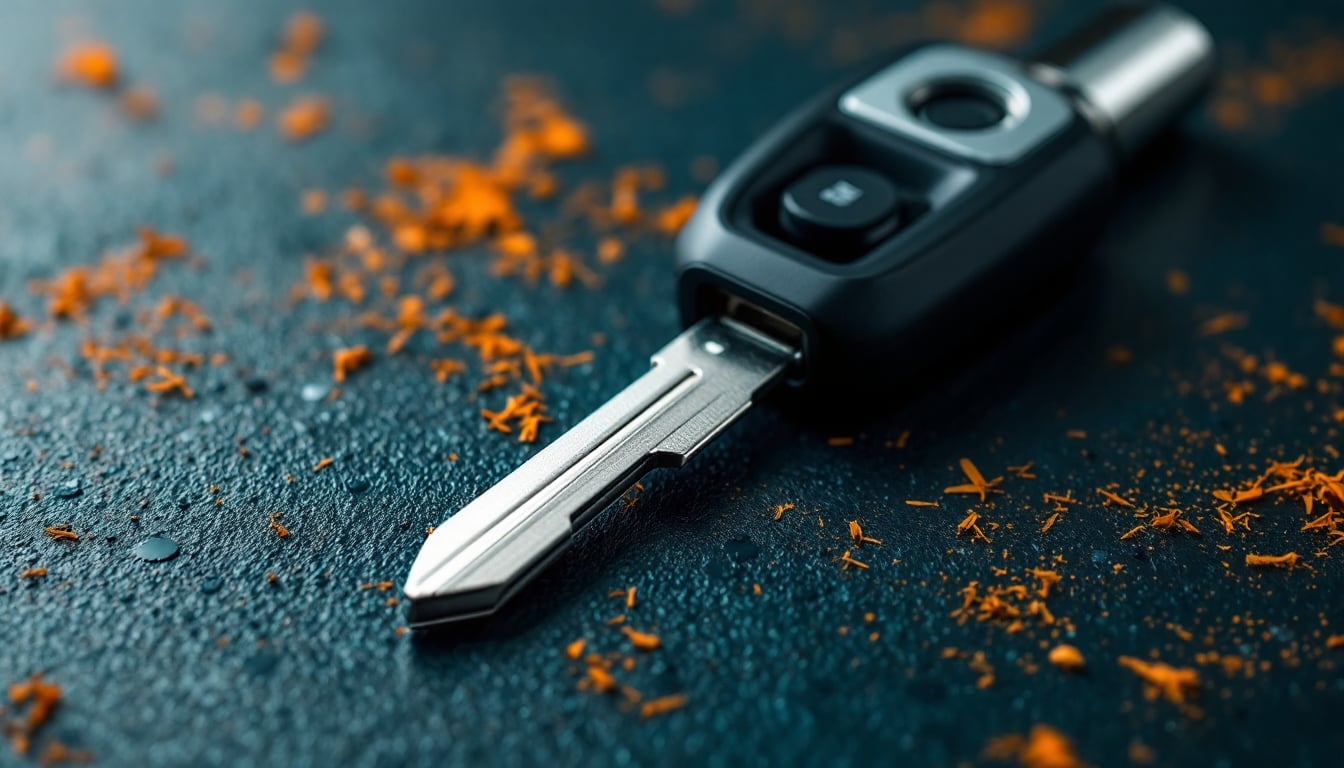
The short answer. A key that slides fully into the ignition but refuses to rotate is a mechanical problem, not an electronic one, and that is good news — the immobilizer, the battery and the starter are all downstream of a cylinder that has not turned yet. Four causes account for nearly all of it: the steering-column lock bearing load, a worn key, worn wafers inside the cylinder, and debris. The first is free to fix in about ten seconds. The rest are priced by which one you have.
KeyAtlas is an independent directory of third-party automotive locksmith businesses. It performs no key cutting, no cylinder work and no service of any kind. This guide explains how the trade diagnoses a non-turning ignition so you can tell a free fix from a paid one before calling anybody.
Start here: the load on the steering lock
Do this before anything else, because it resolves a large share of cases at zero cost.
When you switch a vehicle off and remove the key, a pin drops into the steering column and locks the wheel. If the front wheels are turned — against a kerb, on camber, on a slope — the weight of the car pushes the steering back against that pin. The pin is then under load, and the ignition cylinder is mechanically prevented from rotating. The key is not stuck. The column is.
The release is simple. Take the steering wheel in both hands, apply firm pressure to rotate it one way, and while holding that pressure turn the key gently. If nothing gives, hold pressure the other way and try again. The wheel will move a few degrees and the key will turn.
Two cautions. Apply the force to the wheel, never to the key — a key snapped off inside an ignition converts a free fix into an extraction job, which is its own guide: broken key in the ignition or door lock. And on an automatic, check the selector is fully seated in park rather than resting just short of it, because a selector that has not fully engaged can hold the interlock in place.
If the steering wheel has no play at all in either direction and the key still will not move, the column lock is not your problem and you can move down the list.
The second test: a different key
If you have a spare, use it now. This single test splits the remaining possibilities in half.
- The spare turns normally. The cylinder is healthy. Your everyday key is worn, bent or damaged, and the fix is a key — the cheapest outcome on the list.
- Neither key turns. With the steering lock excluded, attention moves inside the cylinder.
If a spare exists but is in a drawer at home, it is worth the trip to fetch it before booking anything. If no spare exists at all, this failure is the argument for one: see spare car key cost and when to get one.
Why keys stop turning locks they used to turn
Keys wear, and they wear where you cannot see it. Every insertion drags brass or nickel-silver across steel wafers, and the cut peaks lose a fraction of their height each time. The cuts are machined to tolerances measured in thousandths of an inch; the lock needs each wafer lifted to a precise level to line up and release. A key can lose enough material to miss that level while still looking perfectly normal.
Three patterns give it away:
- The key works in the doors and boot but not the ignition. The ignition is used many times more often than any other lock on the vehicle, so it wears first and is least forgiving.
- The key turns only at a specific angle, or with upward or downward pressure applied while turning.
- The key has been copied from a copy. Each duplication reproduces the previous key's wear plus the machine's own tolerance. Three generations from the original and the key can be measurably off-code while working well enough to fool everyone until it does not.
The fix in all three cases is the same and it is not a duplicate. A locksmith cuts a key to code — decoding the vehicle's factory key specification from the VIN, which is what the vehicle identification standard exists to make possible [3], or reading the cylinder directly. A key cut to code is a new original, not a copy of a tired one. On a vehicle with an immobilizer the new key also has to be programmed to the car, which is a separate step from cutting the blade — transponder and smart key programming explained covers why.
This is also the cheapest possible repair, which is why a competent shop will suggest trying it before opening a steering column. The related intermittent case — a key that turns sometimes and not others — is covered in key works sometimes, intermittent no start.
When the cylinder is the problem
Wafers wear too, and springs weaken. A cylinder that has accepted a slightly worn key for years eventually stops tolerating any key at all. High-mileage vehicles and heavy key rings accelerate it — a heavy bunch of keys hanging from the ignition applies constant leverage that the cylinder was never designed to absorb, and it is one of the few genuinely preventable causes on this list.
Higher-mileage vehicles from the 2000s and earlier are the usual population here, and certain domestic platforms of that era are well known in the trade for column-mounted cylinders that wear predictably; the GM key replacement guide covers one such family in more detail. A vehicle's generation also determines how much of the repair is mechanical and how much is electronic — car key technology by model year is the reference for that.
Debris is the last mechanical cause and the easiest to dismiss too quickly. Lint from a pocket, a fragment from a worn key, or the residue left by oil-based sprays can pack the keyway. Which is the reason for the lubricant rule: use a dry lubricant intended for locks. Oil and general-purpose penetrating fluids attract dust and form an abrasive paste that accelerates the wear you were trying to treat.
What each repair actually costs
| Repair | What it involves | Relative cost | When it applies |
|---|---|---|---|
| Key cut to code | Decode the factory specification, cut a new blade, program if required | Lowest — ordinary key-replacement band for the vehicle | Spare turns, or the key is visibly worn or copied |
| Cylinder rebuild | Remove the cylinder, replace worn wafers and springs, re-key to the existing key | Higher — labour-intensive | Cylinder worn but the housing is sound |
| Cylinder replacement | New cylinder fitted, then re-keyed so one key still works all locks | Highest — part plus labour | Cylinder failed or damaged beyond rebuild |
| Extraction plus one of the above | Remove a snapped blade first | Adds an extraction charge | Someone forced the key |
Two notes on reading that table. First, the reason a rebuild or a replacement is quoted higher is labour and access, not parts — reaching a column-mounted cylinder can mean removing trim and, on some vehicles, working around an airbag, which is why it is not a roadside job everywhere. Second, if a cylinder is replaced without re-keying, you end up carrying two different keys for one car; a shop that re-keys the new cylinder to your existing key is saving you that annoyance permanently. General price context for the key half sits in car key replacement cost [2].
What this is not
Three faults get mistaken for a non-turning ignition, and none of them is fixed by a key or a cylinder.
The key turns but nothing happens, or the engine starts and dies. The cylinder rotated, so the mechanical side is fine. That pattern belongs to the immobilizer or an electrical fault — see car starts then shuts off and security light flashing and the car will not start.
A push-button vehicle that will not start. There is no cylinder to turn. That is a fob, battery or antenna question: key fob not working, what to check first.
The key will not come back out once turned. Different mechanism, different fix, and it has its own guide: key stuck in the ignition and will not come out.
If you are still unsure which side of the line your symptom sits on, the broader triage is is it the key or the ignition.
Who to call, and what to tell them
This is squarely automotive locksmith territory rather than general mechanical repair — cutting to code, rebuilding cylinders and re-keying are the trade's core competencies, described in what an automotive locksmith does. A shop will want, in this order: year, make, model and trim; the VIN; whether a spare key turns the ignition; whether the steering wheel has any play; and whether the key has ever been forced.
Ask what the shop will try first. The honest answer on a worn-key presentation is a key cut to code before anything is dismantled, because it is both the likeliest fix and the cheapest. A shop that quotes a cylinder replacement without having seen whether a fresh key solves it is skipping a step. As with any dispatched trade, confirm the business name, the address and the price basis before work begins [1]; the checklist is how to verify an automotive locksmith.
Where this directory fits
KeyAtlas lists independent automotive locksmith businesses across all fifty states and the District of Columbia, sourced from OpenStreetMap under the Open Database License with provenance recorded for every entry. It cuts no keys, rebuilds no cylinders and performs no service of any kind. If the steering-wheel test has not freed your ignition, you can browse listed automotive locksmiths or use the matching service to reach a listed business covering your area.
Frequently asked questions
Why will my key go into the ignition but not turn?
In most cases the steering-column lock is bearing load and has trapped the cylinder. Front wheels turned against a kerb, or parked on a slope, put pressure on the locking pin so the cylinder physically cannot rotate. Firm pressure on the steering wheel left and right while gently turning the key releases it. If that fails, the remaining causes are a worn key, worn wafers inside the cylinder, or debris, in roughly that order of frequency.
How do I free a steering lock that has jammed the key?
Take hold of the steering wheel and rock it firmly but not violently in both directions while applying light, steady turning pressure to the key. Do not force the key itself — a snapped key turns a free fix into an extraction job. On an automatic, also confirm the selector is fully in park rather than resting between positions, because an incompletely seated selector can hold the column lock engaged.
Can a worn key stop turning the ignition?
Yes, and it is the most common mechanical cause after the steering lock. Every insertion abrades the cut edges slightly, so after years of daily use the peaks no longer lift the wafers to the exact height the cylinder needs. The tell is a key that works in the doors but not the ignition, or one that only turns at a particular angle — the ignition is the most-used lock on the vehicle and therefore the first to stop tolerating a tired key.
Is it the key or the ignition cylinder?
The fastest test is a second key. If a spare turns the ignition normally, the cylinder is fine and the first key is worn or damaged. If neither key turns and the steering lock has been ruled out, the fault is more likely inside the cylinder. A key cut fresh to the vehicle's factory code, rather than copied from a worn key, is the decisive diagnostic — and it is also the cheapest possible repair.
What does it cost to fix an ignition that will not turn?
As of September 2026 the cost depends entirely on which of the three repairs you need. A fresh key cut to the vehicle's factory code sits in the ordinary key-replacement band for your vehicle type. Rebuilding a cylinder with new wafers is more, because it is labour-intensive. A complete cylinder replacement is the most expensive, since it adds the part and, on many vehicles, re-keying so that one key still works everything.
Should I spray lubricant into the ignition?
Not an oil-based one. Oil and general-purpose penetrating sprays attract dust that forms an abrasive paste inside the lock and can make a marginal cylinder permanently worse. A dry lubricant intended for locks is the accepted product. If a lock genuinely needs lubricant to function, that is a signal it is wearing out rather than a repair.
Can I still drive if the key eventually turns after a struggle?
You can, but an ignition that needs persuasion is giving notice. The failure mode that follows is usually a key that will not turn at all, or a key that snaps under the extra force people apply — and both happen wherever you happen to be parked. Having the cause identified while the car is still drivable is considerably cheaper than dealing with it in a car park at night.
Sources cited
- Federal Trade Commission — Hiring a Locksmith (2023).
- AAA — Car key replacement cost guidance (2024).
- NHTSA — VIN decoder (vPIC) (2025).