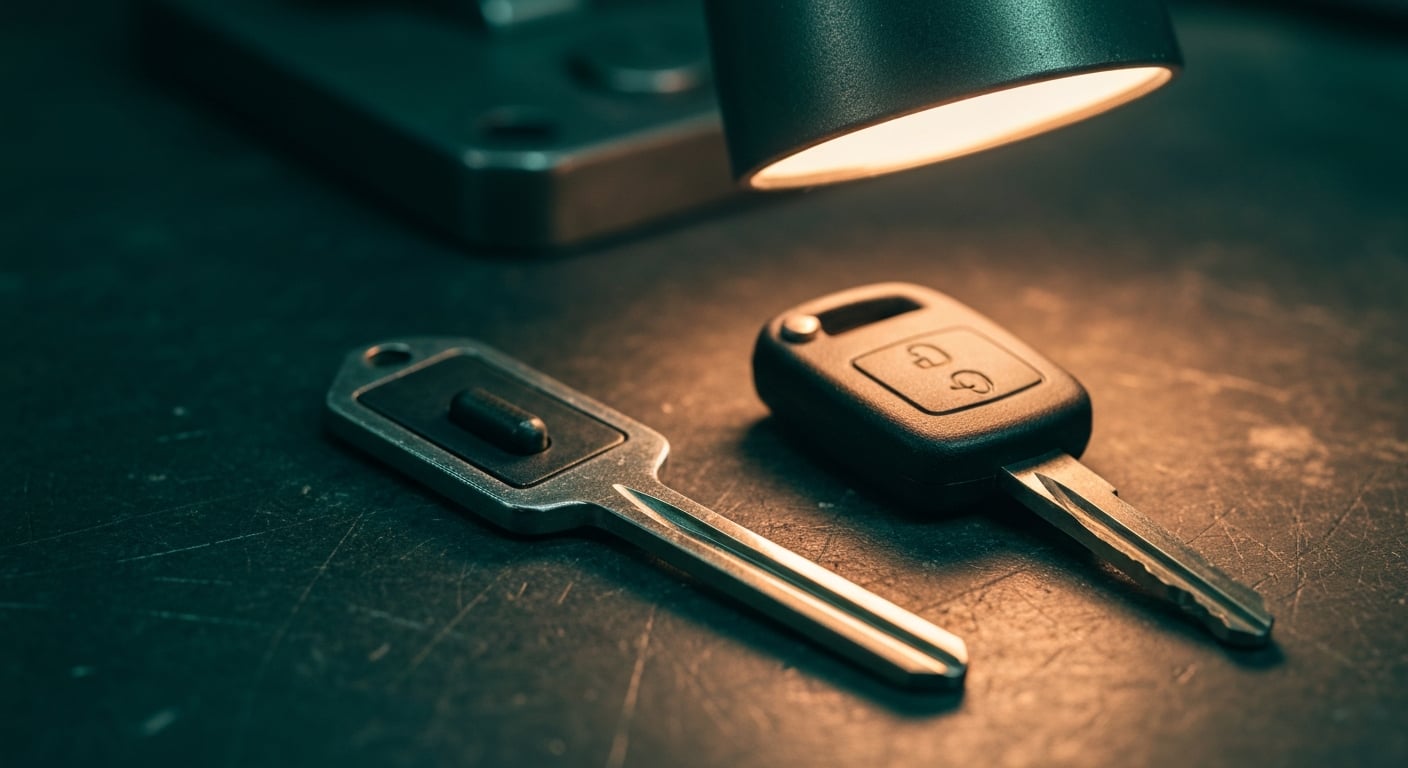
General Motors vehicles produce a question no other make generates quite as often: why is the technician sitting in my truck doing nothing for half an hour?
The answer is a security relearn, and understanding it explains most of what is peculiar about GM key work. As of August 2026, this is an owner-level guide to replacing keys across Chevrolet, GMC, Buick and Cadillac — what your vehicle's era implies, what the security light is actually saying, and how to get a quote that reflects the real visit length.
GM tried three ideas before the modern one
Unlike makes that ran a single immobilizer concept and improved it, GM cycled through genuinely different approaches. Which one you have changes the method completely.
No anti-theft. The oldest trucks, vans and sedans. The key is metal, the job is cutting, and it is the cheapest work in the trade. If your vehicle is old enough that the key has no plastic head and no pellet in the blade, you are in this category.
Resistor pellet in the blade. A small pellet set into the key blade with a specific electrical value that the vehicle reads through contacts in the lock. No radio, no chip, no programming in the modern sense — but a replacement must carry the right value, which is why a plain hardware-store copy opens the doors and refuses to start the engine. Owners of this era discover the distinction the hard way roughly once per generation.
PassLock and related systems. Instead of reading something in the key, the vehicle watches the lock cylinder itself for the correct signal as it turns. The key becomes an ordinary cut key again, and the security lives in the column. This design is the reason a large share of "my key stopped working" complaints on GM vehicles of this era turn out to be a column or wiring fault rather than a key fault at all.
Transponder and proximity. The modern arrangement, shared in principle with the rest of the industry: a chip or a pocket fob answers a challenge, and a new credential is enrolled with diagnostic equipment. The general mechanics are covered in transponder and smart key programming explained.
The vehicle identification number resolves which of these you have in seconds, and the federal vehicle-information decoder will confirm the basic build at home [4].
What each era costs you, relatively
| Era | What the key is | What the visit involves | Relative cost |
|---|---|---|---|
| No anti-theft | Plain cut key | Cutting only | Lowest |
| Resistor pellet | Cut key with correct pellet value | Cutting plus value match | Low |
| PassLock era | Ordinary cut key | Cutting, plus a relearn wait | Low, unless the column is at fault |
| Transponder | Chipped key or remote-head key | Diagnostic programming, often a relearn | Moderate |
| Proximity fob | Pocket fob with hidden blade | Diagnostic programming, verification | Highest |
Two things sit outside that table. Losing every key adds a substantial premium in any era, because the cuts have to be derived rather than copied — the industry-wide picture is in all keys lost and secure data release explained, and published consumer guidance puts modern replacement broadly in the low-to-mid hundreds of dollars with all-keys-lost higher again [3]. And regional labor rates move every number on the page, which the occupational wage data for the trade makes visible [5].
The relearn wait, explained
On several GM generations, enrolling a key or teaching the vehicle a new security signal requires the ignition to sit in a specified state for a fixed period — commonly repeated more than once, so the total runs to roughly half an hour.
It is not padding. It is a deliberate delay engineered into the vehicle precisely so that someone with the wrong key cannot brute-force the system quickly in a parking lot. No tool shortens it, and a shop that promises to skip it is either working on a different vehicle than it thinks or telling you what you want to hear.
The consequence for you is purely practical: ask whether your vehicle needs a relearn when you get the quote. A technician who says "about forty-five minutes on site" for a job with a relearn is being honest; one who says fifteen minutes has probably not identified your vehicle correctly. The general anatomy of where the time goes is in how long car key replacement takes.
Reading the security light
The anti-theft telltale on a GM dashboard is the most useful diagnostic you have before spending money, and it is widely misread.
Light on, engine cranks but will not run. The system is refusing to authorise a start. That refusal can originate at the key, at the reader or contacts in the lock, in the steering-column wiring, or at the anti-theft module. Only the first of those is fixed by a new key.
Light flashing with no crank at all. Frequently points away from the key entirely, toward the ignition switch, the starter circuit or a battery problem.
No light, no crank, no click. Almost never a key problem. Start with the battery.
Everything normal but the remote buttons do nothing. The immobilizer is fine; you have a remote fault, and the first suspect is a coin cell.
That last case is the cheapest fix in this article and the one most often converted into an unnecessary fob purchase — the key fob troubleshooting guide walks it. For the cranks-and-dies case, is it the key or the ignition is the diagnostic sequence to run before you book anything, and it matters more on GM than on most makes because of the PassLock-era column faults.
Work trucks, fleets and shared keys
GM's share of the working-vehicle fleet creates a set of situations that rarely come up on a family sedan.
A truck registered to a company still needs ownership established before a modern key is programmed, since the secure key-data process requires it [1]. In practice that means someone must present documentation tying the vehicle to the business and identification tying themselves to that business. Sorting this out before the technician arrives is the difference between a completed visit and a wasted trip charge; the awkward variants are covered in proof of ownership for car key replacement.
The other fleet-specific question is key count. If four drivers share three keys and one disappears, you may want the missing key positively disabled rather than merely replaced. Say so explicitly — it selects a different procedure, and it is worth knowing that the procedure will also invalidate the keys still in the drivers' pockets, which then need re-enrolling in the same visit.
Getting the quote right
Ask for one total covering part, cutting, programming, travel and any after-hours element, in writing, before anyone is dispatched. Federal consumer guidance singles out a price that changes on arrival and a company that will not identify itself as the two clearest warning signs in this trade [2], and the line-by-line version of a real invoice is in anatomy of a car key quote.
Three GM-specific questions worth adding:
- Does the quote assume a relearn? If yes, the time estimate should reflect it.
- Will my existing keys survive? See the procedure question above.
- If it turns out to be the column rather than the key, what happens? A shop that has an answer — diagnose, quote separately, no key charged — is a shop that has met this vehicle before.
Whether any given business covers your model year comes down to which software subscriptions it currently pays for, which is why two competent shops in the same city give different answers; why locksmith key coverage varies sets out the economics, and dealer versus locksmith compares the two routes on price, speed and capability.
Three checks worth running before you call
Each of these takes under five minutes and each one occasionally saves the entire call-out.
Try the other key. If a second key exists, use it. If the vehicle starts on the second key and not the first, you have isolated the fault to a key — which is genuinely useful, and which also means you should get a replacement while the good one still works. If neither key starts it, the vehicle is the suspect.
Watch the security telltale through a full start attempt. Turn the ignition on without cranking and note what the light does. Steady, flashing, or off are three different messages, and being able to describe the behaviour precisely on the phone gets you a much better answer than "it won't start".
Check the battery properly. Anti-theft systems behave erratically on marginal voltage, and a battery that still cranks the engine can be too weak for a security module to complete its checks reliably. On an older vehicle with a battery of unknown age this is the first thing a good technician will ask about.
One more, specific to the older end of the range: if the key feels loose, sloppy or has to be held in a particular position, the ignition lock cylinder has wear. That is a mechanical repair, not a key job, and cutting a fresh key onto a worn cylinder occasionally makes the symptom worse rather than better.
Before you close the tab
If your GM currently has exactly one working key, the useful action today is a spare. Every era in the table above is cheaper to duplicate than to originate, and on the proximity end the gap is large enough to be worth a calendar reminder — the economics are laid out in what a spare car key costs and when to get one.
KeyAtlas is a directory rather than a locksmith. Search the directory for automotive locksmiths listed near you, or get matched to send your vehicle details to screened specialists in one message.
Frequently asked questions
Why does a GM key job involve a thirty-minute wait?
Several GM anti-theft generations use a security relearn that requires the ignition to sit in a particular state for a fixed period, repeated more than once. It is a deliberate delay built into the vehicle, not the technician being slow, and it cannot be shortened. Ask whether your vehicle needs one when you get the quote so the time estimate you are given is the real one.
What is the little pellet in the blade of my older Chevrolet key?
On a number of older GM vehicles the key blade carries a small resistor pellet, and the vehicle checks its electrical value as part of the anti-theft system. It is an early, entirely electrical form of key security with no radio chip involved. A replacement has to carry the correct value as well as the correct cuts, which is why a plain copy from a hardware store will open the door and not start the engine.
The security light is on and my GM will not start. Is the key the problem?
Not necessarily. A lit security or anti-theft telltale means the system is refusing to authorise a start, and the cause can be the key, the reader around the ignition, wiring in the steering column, or the anti-theft module itself. On older vehicles column wiring is a common culprit. Have the cause diagnosed before buying a key, because a new key does not fix a vehicle-side fault.
Can a locksmith replace a Chevrolet or GMC key fob?
For most GM vehicles in general circulation, yes, including cutting the blade and programming the credential. The newest model years are the usual exception, since blanks and software coverage lag the vehicle. Confirm against your vehicle identification number rather than against the model name, because trims within one model year can differ.
Do older GM trucks need programming at all?
The oldest ones do not. A pre-anti-theft truck key is a cut piece of metal and nothing more, which makes it the cheapest key work available. Once resistor pellets, PassLock or transponders arrived, some form of matching or programming became part of every replacement.
Will a new key erase my existing GM keys?
It can, depending on the procedure used. Some relearn routines clear every previously programmed key, which is exactly what you want when one is genuinely lost and you would like it disabled, and exactly what you do not want when you are simply adding a spare. Ask which behaviour applies before the work starts.
Sources cited
- National Automotive Service Task Force — Secure Data Release System & Vehicle Security Professional registry (2024).
- Federal Trade Commission — Hiring a Locksmith (2023).
- AAA — Car key replacement cost guidance (2024).
- National Highway Traffic Safety Administration — VIN decoder, vPIC (2025).
- U.S. Bureau of Labor Statistics — Occupational employment and wages, locksmiths and safe repairers 49-3071 (2024).