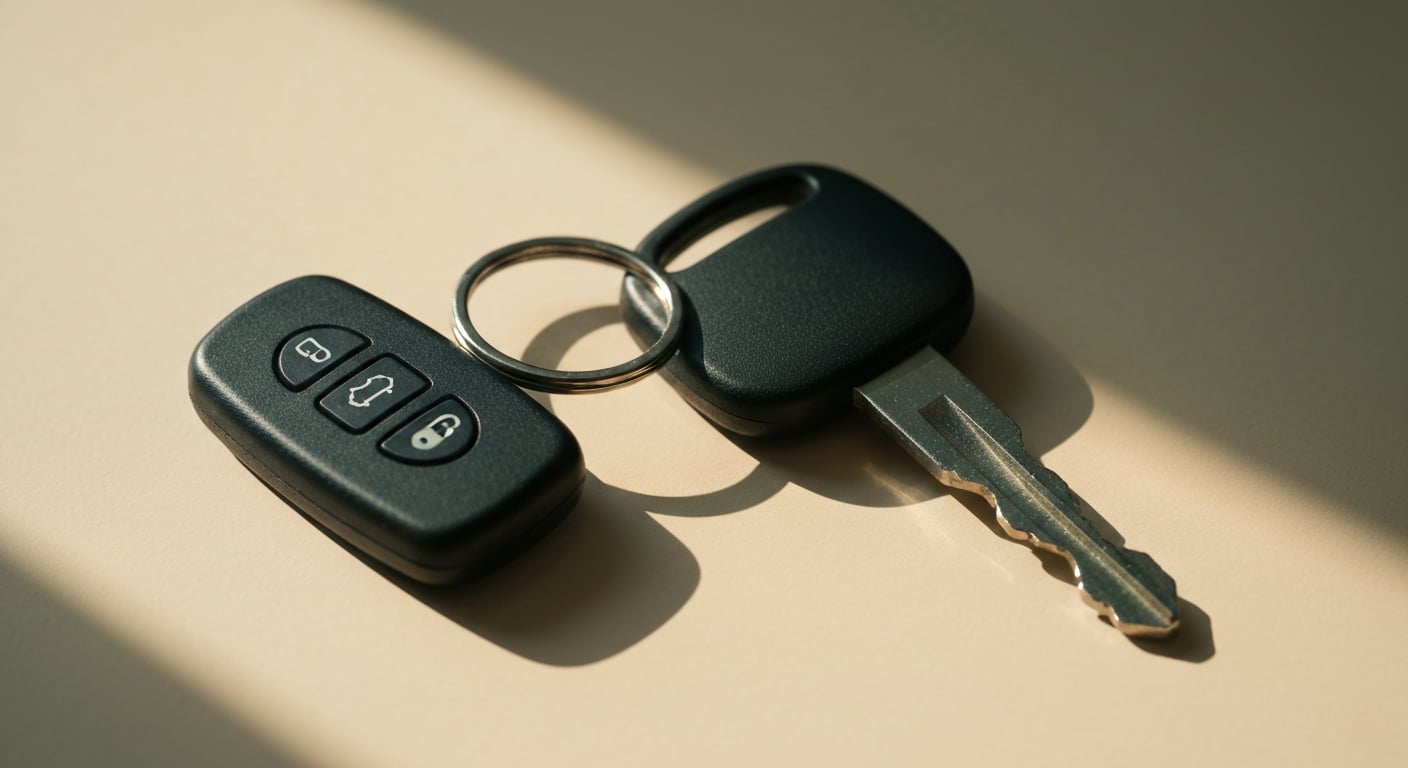
Honda owners buy the wrong part more often than owners of almost any other make, and the reason is structural rather than careless. On a great many Honda and Acura vehicles the thing that starts the car and the thing that locks the doors are two separate objects sharing one keyring.
As of August 2026, this guide covers what to check before spending anything, how the immobilizer generations differ, and what changes once a Honda has a push-button start.
The two-object problem
Across a long run of Honda and Acura models, the arrangement was this: a bladed key with an immobilizer chip in the head, plus a small separate remote with lock, unlock and panic buttons. Two devices, two batteries in the sense that one has a coin cell and the other has none, two entirely independent failure modes.
That produces a diagnostic shortcut worth memorising:
- Car starts, buttons dead → the remote failed. The key and its chip are provably fine, because the engine ran.
- Buttons work, car cranks and dies → the immobilizer refused. The remote is fine; the problem is the key credential or the vehicle side of the system.
- Nothing at all → look at the vehicle battery before anything else.
Later Honda models folded both functions into a single remote-head key, and later still into a proximity fob with a hidden emergency blade. If you own one of those, you are back to one object with one failure — but the first case above still holds, because a fob whose buttons have died can usually still start the vehicle by being held against the start button.
The full triage sequence, applicable to any make, is in the key fob replacement guide, and the vocabulary in any quote you receive is decoded in the car key terminology glossary.
What the immobilizer actually requires
Once Honda began fitting immobilizers, a cut key stopped being enough. The chip in the head has to be enrolled in the vehicle security system with diagnostic equipment; without that, a perfectly cut key opens the doors, turns in the ignition, and will not keep the engine running.
This is the single most misunderstood point in Honda key work, because the failure looks like a bad copy rather than a missing programming step. The general mechanics are covered in transponder and smart key programming explained, and the cost shape of that programming is in transponder key programming cost.
The corollary matters too: the owner-performed remote-pairing sequence some Honda models support does not touch the immobilizer. It pairs buttons. It cannot make a non-starting vehicle start, and no amount of repeating it will change that. If you find a procedure online and it does not fix your no-start, the procedure was not the wrong one — it was the wrong problem.
Reading your own key
| What you are holding | What it does | If it fails |
|---|---|---|
| Plain bladed key, no chip | Older pre-immobilizer models | Cut a copy, no programming |
| Bladed chip key plus separate remote | Starts the car; remote handles doors | Diagnose which half failed first |
| Remote-head key, one piece | Both functions in one object | Replacement covers both |
| Proximity fob with hidden blade | Push-button start models | Highest cost of the four |
| Emergency blade only | Inside a proximity fob | Opens the door, will not start the car |
If you are shopping for a replacement remote or fob online, the equipment authorization identifier printed on the existing one is the most reliable compatibility check a consumer has, and the federal database behind it is public [4]. Matching that identifier is not a guarantee — but a mismatch is close to a guarantee of a part that cannot be programmed. The wider case for and against buying your own part is in OEM versus aftermarket car keys.
The push-button era
Acura moved to proximity fobs earlier and more comprehensively than Honda, so the split across the two brands is not even. Practically, a recent Acura owner is more likely to be replacing the expensive kind of credential than a Honda owner of the same vintage.
Replacing a proximity fob involves the same three cost components as everywhere else — the fob itself, the emergency blade cut, and the programming — with the fob dominating. Published consumer guidance puts modern replacement broadly in the low-to-mid hundreds of dollars, higher for proximity systems and higher again with no working key [3]. Ways to bring that number down without buying something that fails are collected in affordable smart key replacement options.
One Honda-specific detail worth asking about: does the quoted fob include the emergency blade being cut? An uncut blade is not a hardship until the day the fob battery dies in a parking garage, at which point it is the only way into the car.
All keys lost
With nothing left that works, a technician cannot copy or add — the key has to be originated. The mechanical cuts are derived rather than duplicated, and a credential the vehicle has never seen has to be enrolled, which on a modern Honda or Acura means authenticated access to manufacturer security data through the recognised industry channel [1].
That channel requires the technician to establish that the vehicle is yours. Have the registration or title and matching photo identification ready before the visit; the awkward cases — a vehicle still titled to a seller, a car registered to a spouse or a company — are covered in proof of ownership for car key replacement, and the process end to end is in all keys lost and secure data release explained.
Worth knowing before you assume the cost is unavoidable: some policies and memberships contribute toward key replacement, and the conditions are narrower than people expect. Does insurance cover car key replacement sets out when it genuinely applies.
Choosing who does the work
Ask for one total covering the part, the cutting, the programming and the travel, in writing, before anyone is dispatched. Federal consumer guidance is direct that a quote which changes on arrival, and a company that will not identify itself, are the two clearest warning signs in this trade [2]. Trade bodies publish professional standards and maintain a locksmith finder you can cross-reference against whatever you found in a search [5].
Three questions specific to a Honda or Acura call:
- Am I buying a key, a remote, or both? Answer the two-object question before you agree to anything. On the separate-remote models, buying both when only one failed is the commonest overspend on this make.
- Is the immobilizer enrollment included in the price? It must be, on any vehicle that has one.
- Does the shop cover my model year? Coverage is a function of which software subscriptions the business currently pays for, not of general skill — which is why two good shops in the same city answer differently. Why locksmith key coverage varies explains the economics; how to verify an automotive locksmith is the seven-point check to run before you hand over a card.
Higher-mileage Hondas and the wear question
These vehicles routinely pass two hundred thousand miles, and at that age the lock hardware has done as much work as the engine. Two consequences worth knowing before you spend anything on a key.
A worn ignition cylinder can imitate a key fault. If the key has to be jiggled, held at an angle, or pushed in slightly further than it used to, the wear is in the lock rather than in the key. A crisply cut new key sometimes makes this worse: the old key had worn to match the worn cylinder, and a correctly cut one no longer does. Diagnose before replacing — is it the key or the ignition walks the distinction.
A worn key can be a bad copy source. If your only remaining key is rounded and thin, cutting a duplicate from it copies the wear. A technician who can cut to the vehicle's key code instead of copying the physical key will produce a better result, and it is worth asking which method they intend to use.
Neither of these is a reason to delay. They are a reason to describe the symptom accurately rather than simply ordering a key, because the two repairs have very different prices and only one of them fixes a worn cylinder.
What to have ready before the visit
Assemble these while you wait and the appointment gets materially shorter:
- Year, model and the vehicle identification number — visible at the base of the windshield on the driver's side and on the door jamb sticker.
- Proof of ownership — registration, title, or a current insurance document naming you, plus matching photo identification.
- Every key and remote you still have, working or not. A dead remote is still useful information, and a working key changes the procedure entirely.
- A clear answer on how the vehicle currently behaves — starts and runs, cranks and dies, or nothing at all.
The action worth taking today
If your Honda or Acura currently has one working key, get a spare while that key exists. Adding a credential to a vehicle that already trusts one is routine work; originating from nothing is the most expensive job in this article. The gap is not marginal, and the only input you control is timing — the arithmetic is in what a spare car key costs and when to get one.
KeyAtlas is a directory, not a locksmith. Search the directory for automotive locksmiths listed near you, or get matched to send your vehicle details to screened car-key specialists in one message.
Frequently asked questions
Why does my Honda have a separate key and remote?
Across a long run of Honda and Acura models the immobilizer credential lived in the key while the lock and unlock buttons lived in a separate remote on the same ring. They are independent devices: the key can work perfectly while the remote is dead, and the remote can work while the key has failed. Later models combined the two into one remote-head key or replaced both with a push-button proximity fob.
My Honda remote stopped working but the car still starts. What do I need?
Almost certainly a remote, not a key. If the engine starts and runs normally, the immobilizer is satisfied and the chip in your key is fine. Start with the coin cell inside the remote, which is the single most common cause and the cheapest to rule out, before buying anything else.
Can I program a Honda remote myself?
Some Honda and Acura models support an owner-performed remote-pairing sequence involving the ignition and the driver door lock, and it is model specific. It pairs the remote buttons only — it never enrolls an immobilizer credential, so it cannot make a non-starting vehicle start. Check your owner manual for the sequence that applies to your exact model and year.
Does a Honda key need programming to start the car?
On any Honda or Acura fitted with an immobilizer, yes. The chip in the key has to be enrolled into the vehicle security system with diagnostic equipment before the engine will keep running, so a mechanically cut copy alone will open the doors and turn the ignition without starting the car.
Are Acura keys different from Honda keys?
They share the same underlying platforms and security families, so the work is similar. What differs is the mix: Acura moved to proximity fobs and higher-specification keys earlier and more broadly across the range, so an Acura owner is more likely to be replacing the more expensive kind of credential.
What happens if I lose every key to my Honda?
The technician has to originate a key rather than copy one, deriving the mechanical cuts and enrolling a credential the vehicle has never seen. That involves authenticated access to manufacturer security data, so expect to prove the vehicle is yours with registration or title and matching photo identification. It is the most expensive version of this job on any make.
Sources cited
- National Automotive Service Task Force — Secure Data Release System & Vehicle Security Professional registry (2024).
- Federal Trade Commission — Hiring a Locksmith (2023).
- AAA — Car key replacement cost guidance (2024).
- Federal Communications Commission — Equipment Authorization (FCC ID) search (2025).
- Associated Locksmiths of America — Professional standards & Find a Locksmith (2024).